
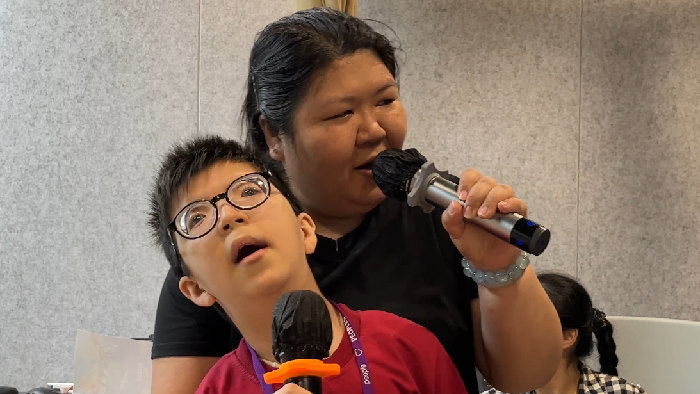
Rubinstein-Taybi Syndrome Boy - Lam Pok-yin
"What's the next stop?" "The next stop is Long Ping, then Tin Shui Wai, Siu Hong..."
In the West Rail Line train compartment, 11-year-old Pok Yin didn't even lift his head, reciting the stations from memory one by one. He had long memorized the route because his mother, Mrs. Lam, who single-handedly cares for her son with the rare condition Rubinstein-Taybi Syndrome (RSTS), hopes her nearly blind son with 1900-degree myopia will be prepared for the future: "Even if he can't see things in the future, it doesn't matter. As long as he remembers all the stations, he can get around by himself."
On the day of the interview, Mrs. Lam, who had just twisted her back, endured the pain and traveled from her home in Tuen Mun to Ebenezer School & Home for the Visually Impaired in Pok Fu Lam Road, Hong Kong Island, to pick up Pok Yin from school. Then, they took a bus, West Rail Line, and Light Rail to rush to the Tuen Mun Eye Centre for a follow-up appointment. After much travel, they finally arrived home by car in the evening. Although she has to make a long journey every week to pick up and drop off Bo Yin at the dormitory, Mrs. Lam prefers to have Pok Yin transferred from a special school in Tuen Mun to Ebenezer School & Home, far away, so he can learn Braille and play the piano as early as possible, preparing him for potential blindness in the future.
"I want him to develop an interest [in playing the piano], so even if, touchwood, God forbid, he really can't see in the future, if he becomes very good at playing the piano, he can teach piano as a skill, or tune pianos by ear."
"I am Lam Pok Yin, I am 11 years old, I have a condition... R... R... S... STS." Pok Yin, wearing thick glasses, shook his head, his watery eyes looking up at the ceiling, and with his mother's prompting, he spoke the name of his rare disease word by word. With a small face, downward-sloping eyes, and a hooked nose, Bo Yin seemed to be constantly squinting and smiling; these are some of the characteristics of the rare condition Rubinstein-Taybi Syndrome (RSTS).
"When he was born, he couldn't swallow, so he had to be fed through a nasogastric tube and stayed in the hospital for almost a month before being discharged." After being discharged, Mrs. Lam felt there was something wrong with his eyes. "He would squint when he saw light, was very sensitive to light, couldn't focus, and rarely cried." Although the nurse at the Maternal and Child Health Centre thought this new mother was overly anxious, she trusted her observations and sought medical help. After being referred to a government ophthalmologist, she faced a long wait for an appointment.


Coincidentally, Pok Yin developed a fever after vaccination. While others saw it as adding insult to injury, Mrs. Lam seized the opportunity to take Pok Yin to the emergency room at Queen Mary Hospital for a general check-up. To her shock, she discovered Pok Yin had glaucoma, and his intraocular pressure could damage his optic nerve at any time. Doctors performed surgery on Pok Yin and suspected his condition was caused by a genetic disorder. He was subsequently referred to genetics for a blood test, which was sent to the US for analysis. At 18 months old, Pok Yin was confirmed to have a chromosomal abnormality on chromosome 16, diagnosing him with Rubinstein-Taybi Syndrome, the 41st recorded case in Hong Kong.
Patients with Rubinstein-Taybi syndrome have broad thumbs and big toes, hence it is also known as "broad thumb-hallux syndrome". Patients may experience intellectual disabilities, developmental delays, cardiac, pulmonary, and skeletal abnormalities, cryptorchidism, epilepsy, short stature, hypotonia, and a higher chance of developing tumors, lymphoma, or leukemia.
"He's eleven or twelve now, but his body size is like a seven or eight-year-old child," said Mrs. Lam. Many patients pass away at a young age due to heart and lung defects. "There's no medicine or cure for these rare diseases, only targeted surgical treatments, meaning treating symptoms as they arise."
Pok Yin once developed enlarged blood vessels and needed heart surgery, but it was postponed because he had chickenpox. During this time, his blood vessels miraculously returned to normal, and he no longer needed surgery, leaving only two scars on his chest from scratching the chickenpox. "I always recite scriptures for him, hoping that even if he has to suffer, his suffering will be lighter and less painful. Maybe it's truly 'turning severe misfortune into minor one,' and he's endured these two scars instead."
Pok Yin started going in and out of the operating room at three months old. By the time of the interview, he had undergone 9 surgeries, big and small. In addition to multiple glaucoma treatments, there were surgical scars all over his body, including his hip joints. "Seeing him come out of the operating room again and again, you become very worried and disheartened."
Pok Yin's father couldn't handle the pressure and chose to leave when Pok Yin was still an infant. "He (her ex-husband) thought the survival rate wasn't high, so why spend so much money to treat him? I think he was too pessimistic. Doctors have a responsibility to explain surgical risks, and he took it all to heart. But when you raise a child and watch them grow, you witness them overcoming difficulties and obstacles."
The impact of the divorce plunged Pok Yin's mother into depression for a time. "I had completely lost hope, but my father told me: if I wasn't strong, Pok Yin would only face a 'dead end'!" This made her realize that she was her son's sole support; her son also became her motivation to overcome her low spirits. Now, she has no resentment towards her ex-husband. Instead, she thanks him for bringing Pok Yin into her life and for making her stronger.


Pok Yin can't see clearly, but he walks faster than an adult. After getting off the bus with the Lifewire team, his mother was busy putting away her wallet, and Pok Yin, unable to see the direction, stood swaying in place; as soon as his mother took his hand, he confidently rushed in the direction his mother led, leaving the Lifewire team behind in an instant. His mother had to pull him to slow down along the way: "Pok Yin! Don't walk so fast, Mommy hurt her back earlier and it's very painful."
Pok Yin's ability to walk briskly, defying the fate of a "low survival rate," is entirely due to his mother's eagerness to learn: reading books, searching online, asking people, and "finding solutions" to bring a ray of light into her son's gradually darkening world.
When Pok Yin was little, his lungs were weak, and his breathing made a "he he hea hea" sound. His mother played bubble-blowing games with him to train his lung capacity.
Pok Yin didn't even know how to swallow saliva, so his mother bought him a T-shaped teether to chew on to train his mouth muscles; she spent hours every day practicing muscle coordination and sphincter control with him, so that by the time he was four or five, he could finally eat by himself, without needing a feeding tube.
Children with RSTS have hypotonia (low muscle tone), so she had Pok Yin lift water bottles to train his muscles; she also combined Chinese and Western medicine, taking Bo Yin for acupuncture, ear points, stretching, and massage to improve his health.


The average IQ of RSTS patients is around 36-51. Although Pok Yin was diagnosed with moderate intellectual disability, his mother firmly believes that his performance during tests was merely subpar, affecting his score, and is determined to overturn the test results through hard work. "Initially, he couldn't even pronounce ABCD, but now the school is training him to be a junior MC!" The cheerful Pok Yin often takes the initiative to chat with the Lifewire team and performs songs. The speech therapy, costing 720 yuan per session weekly, is very important, but his mother's patient daily practice is even more crucial. "Even the speech therapist said, 'We can see how much effort you put into training your son to swallow saliva and food.'"
Not only did he surprise the doctors who watched him grow up, but one doctor even called him a miracle.


However, the efforts of the mother and son could not stop the worsening of his glaucoma. Although he underwent continuous surgeries to reduce pressure on his eyes, Pok Yin's field of vision, which was once a 16:9 image like that of a normal person, continued to narrow and will eventually lead to complete blindness. With his current 1,900-degree myopia, he can only see light and outlines, but this doesn't hinder his curiosity about the world. During lunch, he fumbled around and accidentally knocked over his water. After being scolded by his mother, he lowered his head and apologized, hugging his mother and saying, "I won't dare next time, Mommy, please forgive me." Mrs. Lam smiled and said, "Hearing him sweet-talk you makes you melt, and all your anger disappears!"
Another time, at a pep rally for Pok Yin before his surgery, he hugged his mother and sang "World Only" and "Love is Unreserved"; he also said, "Mommy, I Love You." The mother and son never hesitated to express their love openly. His mother touched deeply and spoke her heartfelt words: "Mommy just wants you to be healthy." The team was moved to tears.
Discrimination is the most hurtful, turning into strong motivation
Pok Yin made her laugh, but the discrimination from others made her angry and unwilling to accept it. Mrs. Lam's eyes welled up with tears as she recalled the most hurtful incident. When Pok Yin was little, he had hyperactivity. Once, he lay on the MTR floor and refused to get up. Other passengers pointed and criticized, "The more you tell him off (Pok Yin), the more he takes off his socks and shoes and throws them at you, and says, 'What's it to you?'" Later, he even wanted to take off his clothes.
"I stopped him and said, 'Taking off your clothes is something I know you can control, you can't do that!'" She told Pok Yin to count to ten slowly in his mind and imagine the sounds of birds around him, to calm himself down. "Children need to be given space to think. The lessons they learn themselves are better than what they get from being scolded by you."


Extremely active, dealt with patience
Mrs. Lam, who constantly reads psychology books and explores methods to teach Pok Yin, believes the best way to stop Pok Yin from sitting on the ground is to make him reflect on why he should sit in a dirty place. She also takes him to suitable places like beaches and parks where he can sit to his heart's content.
Regarding the accusations from others that parents of hyperactive children "don't know how to discipline," she retorted, "Even doctors can't control it, so how can I, a mother, make him stop shouting with just one sentence? If you can do it, I'll treat you to tea!" Outsiders don't understand that parents actually long for their children to be "obedient" even more than they do.
"Every time bystanders make cold remarks, they misunderstand that the child is naughty." She described these children as instruments that, if tuned properly, can also produce beautiful music. "He can't even control his own movements, and even doctors can't control it, so why should we look down on him?"
"I'm quite interesting; the more you discriminate against me, the more I feel you're encouraging me to be strong!"


A message to other families with rare diseases
Speech therapy, physical therapy, acupuncture... the mother and son's living expenses and medical costs are supported solely by disability allowances and the mother's income as a sales assistant. During Pok Yin's early summer holiday due to the pandemic, his mother had to provide full-time care, and her income drastically decreased. "Twenty dollars for pork, twelve dollars for a catty of vegetables, split into two meals!" Despite this, she insists on not claiming Comprehensive Social Security Assistance (CSSA), hoping to be self-reliant. When interviewed by us, she also said she would donate part of the charitable funds to "Harmony Music," a charity that assists people with physical and mental disabilities and their families, hoping to help more people in need.
"I hope all parents of children with rare diseases can be strong!" "I want to tell parents of children with rare diseases or other illnesses that once you give up, the child's condition will worsen; when you are positive, the law of attraction will bring positivity back, leading towards the right path."
Her son was hospitalized at Queen Mary and Duchess of Kent Children's Hospital for three years since birth, and she witnessed many cases where parents of other sick children in the same room chose to abandon their children. "They would sign a paper and hand them over to the Social Welfare Department. I saw Social Welfare Department staff only performing routine checks each time: 'Nurse, what's happened to him recently?' After speaking, they would leave without any display of affection. No hugging, kissing, or combing their hair like a mother would. So I feel there's a definite difference between the Social Welfare Department and a mother."
"I've seen many children who passed away after being handed over to the Social Welfare Department; their conditions worsened." "If you visit them (children) more, they will know there is love, and children will show good performance in return."
She believes Pok Yin is definitely not a burden. With careful guidance and love, his self-care abilities have significantly improved, and he has recently been actively learning music, hoping to find a way forward.
"Actually, problems arise every day, but I think there are even more solutions. When you face them positively, the people around you and heaven will see your efforts and will surely provide you with a good path to walk!"


Interviewer & Writer: Xiao Kai Zhi, Chan Wai Kei
Editor: Chan Wai Kei, Leung Kim Hung
Photographer: Lam Pak Kwan