Mother and Child with the Same Disease: Rare Genetic Disorder ATAD3A - Wong Wei-long
"Roll camera, ready, ACTION!"
At 18, he has a childlike face that seems stuck in time; his body is deteriorating before it has even fully developed.
Delayed medical attention, repeated misdiagnoses, and two rare diseases have led to endless surgeries and suffering.
This is the fourth case in Hong Kong where both mother and son suffer from an incurable disease. "I really don't dare to think about the worst-case scenario..."
Thoughts of "Am I useless?" occasionally surface, but more often, he stages optimistic internal monologues daily.
If life is a script, Wong Wai-lung's self-directed comedy is a blueprint for encouraging those around him to find joy in hardship.
"The hospital is a place of helplessness and many horrors." No one looks forward to a cold, sterile ward. At just four months old, Wai-lung underwent cataract surgery, and at two, he needed an artificial lens implanted. "Congenital Cataract, Hypotonia, Pectus Carinatum..." Holding a medical record of ATAD3A gene mutation, the simple letters form a bewildering combination, hard to understand even when translated into Chinese. Yet, young Wai-lung has been battling these symptoms all his life.
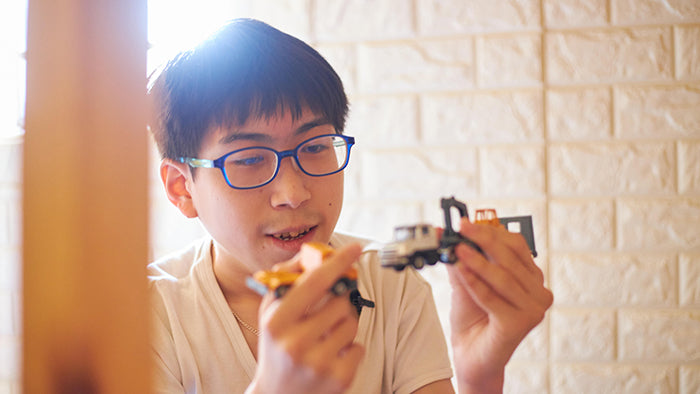
Unable to stand for long, unable to eat normally, Wai-lung appears small and thin, like a junior high student. But he loves to gesticulate, and even more, he loves to play different roles and act out internal monologues with himself, making his mother and the Lifewire team burst into laughter. He has silently endured the pain of his incurable disease without complaint, actively spreading joy and becoming everyone's ray of sunshine.


Spinal curvature misdiagnosed as hunchback; mother and son suffer from incurable disease
"Normally, a baby might learn to roll over at 6 months, but he couldn't then," his mother recalled. Wai-lung's development lagged behind his peers; he could only walk independently at nearly two years old, and only for very short periods. "He'd lose his balance after about 10 minutes, and even now at 18, he still needs support to walk."
Visiting orthopaedic clinics, measuring spinal curvature, and getting X-rays were routine for Wai-lung. The hospital initially diagnosed him with a hunchback and suggested surgery after he became an adult. But in 2019, the genetics department at Queen Mary Hospital called his mother, stating that Wai-lung had the rare genetic disease ATAD3A, the fourth case in Hong Kong. After examination, it was discovered that his mother also suffered from the same disease, albeit a different, milder type. Upon hearing the devastating news, she suddenly realized: "It wasn't a hunchback; it was scoliosis."
Earlier, when Wai-lung was in third grade, doctors found that he was missing his ninth chromosome, leading to developmental delays. "He's still growing very slowly; at 18 this year, he's only reached 150 cm." After diagnosing ATAD3A, doctors warned that Wai-lung would experience premature cognitive decline, similar to dementia in the elderly, and early aging. Even before fully developing, young Wai-lung's body is deteriorating like an elderly person's.


Suffering from Guillain-Barré syndrome, legs felt broken due to weakness
In 2017, 13-year-old Wai-lung developed a high fever and other symptoms after receiving a flu vaccination. His mother initially thought it was a normal reaction to the shot but then noticed something was wrong. "After that shot, he wouldn't eat, and he walked erratically, like his whole body wasn't his own. He had a fever of over 38 degrees for three days." Even after taking fever reducers, the symptoms didn't subside. His mother took Wai-lung to the emergency room, where she was initially advised to leave, but she insisted on admitting her son. After multiple referrals and a bone marrow aspiration arranged by a paediatrician, Wai-lung was diagnosed with Guillain-Barré syndrome.
Guillain-Barré syndrome is a rare autoimmune disorder that affects the peripheral nervous system, including nerves controlling limb movement and various body parts. His mother described Wai-lung at the time as having weak limbs; he couldn't walk more than a few steps before kneeling and needing support, "like his legs were broken." Wai-lung stayed in the hospital for over two months, receiving intravenous immunoglobulin, but even after discharge, his body never fully recovered.
Considering Wai-lung's complex medical history, his mother decided to arrange scoliosis surgery for him when he was 17, using a brace to straighten his spine, which had a curve of nearly 70 degrees. After the surgery, Wai-lung was monitored in the intensive care unit. He recalled with lingering fear: "When I opened my eyes, the incision hurt terribly, my whole body was stiff and I couldn't move at all, lying in bed connected to tubes." Fortunately, the surgery went relatively smoothly. On the day of the interview, Wai-lung's back looked much straighter, but after overcoming spinal surgery, another challenge immediately followed.


Repeated Misdiagnoses: Nasogastric tube worsened muscle laxity
"He's had pneumonia once a year since birth, but doctors always treated it as an upper respiratory infection like the flu." Wai-lung was frequently hospitalized for pneumonia from a young age, but the root cause was never identified or treated. "After learning about this disease in 2019 and getting a 3D X-ray, the doctor told me that the pneumonia wasn't due to the flu; it was because he inhaled food particles into his lungs, which then got moldy."
Previously, doctors had diagnosed Wai-lung's condition as dysphagia and inserted a nasogastric tube for nearly two years. However, after his spinal surgery at Queen Mary Hospital, a more experienced doctor asked his mother, "Why does he have a nasogastric tube? Your son doesn't have dysphagia; it's muscle laxity causing food to go into his lungs." Since nasogastric tubes must be changed regularly, the repeated insertion and removal aggravated the muscle laxity: "Now his cardiac sphincter muscle can't close properly."


Gastrostomy surgery imminent, fears of losing ability to walk
Wai-lung's esophageal muscles had become lax due to the two years of nasogastric tube use. He recalled, "After the (scoliosis) surgery, I tried inserting the tube for the first couple of days, but it wasn't successful. We tried a few more times at Tuen Mun Hospital, but it still didn't work, so we decided to do a gastrostomy."
As the surgery date approaches, Wai-lung, who usually keeps a cheerful facade, frowned and let out a deep sigh: "My greatest hope is that I won't need the surgery. I don't want it to affect my future life." Despite his frequent hospital visits, Wai-lung expressed particular worry about the gastrostomy. "Talking about this makes me a bit unhappy. I am worried, and I have many concerns: future care, the fear of losing the ability to walk and needing a wheelchair, I've imagined myself on a ventilator, and I also worry about my mother's health. I really don't dare to talk about the worst-case scenario..." Wai-lung, usually a chatterbox, suddenly fell silent.


Marginalized during the pandemic: "Did the government care about us?"
Although there is currently no data proving a direct link between flu vaccination and Guillain-Barré syndrome, Wai-lung's attending physician at the time advised him to avoid further vaccinations. However, due to pandemic prevention policies, his mother had to find a way forward for Wai-lung. She informed the doctors about her son's condition and tried to apply for a vaccine exemption. After weighing the risks of pneumonia infection versus a Guillain-Barré relapse, the doctors ultimately decided to follow government guidelines and only exempted Wai-lung from the Sinovac vaccine. His mother had no choice but to brace herself and take him for the BioNTech vaccine: "If he caught that specific germ again, he might truly fall into a coma, and we wouldn't even know."
Due to the pandemic, classes were suspended, and Wai-lung described the two years of online classes as "a complete mess." On the day of the interview, Wai-lung was still on summer vacation, and the next year would be his last in secondary school: "It's like a magnified hourglass where all the sand rushes through; it passes so quickly."
The pandemic brought stagnation to all industries, and student progress was no exception, especially for children with special needs. His mother couldn't help but complain: "With the pandemic like this, did the government mention a single word? Special needs children need extra attention. I know many people around me who have similar problems, and everyone cries uncontrollably when they talk about it!" She described the current situation as being abandoned by the government, while some community organizations pay attention to the circumstances of special needs families, caring not only for the children but also for the caregivers' emotional well-being.


Physical limitations, endless cinematic dreams
Wai-lung, who has hyperactivity, often cannot sit still despite his physical weakness: "Sometimes when he runs, he loses control and bumps into walls." Later, his mother discovered that Wai-lung could concentrate while drumming, so she found him a teacher, hoping he could pursue his interest and channel his accumulated frustrations: "He is very patient in learning, and after learning, he remembers things very well. I told him, 'If you have any frustrations, hit the drum loudly during class, the drum won't break.'"
His mother also arranged for Wai-lung to act in films: "He was in 'Caught in Time' before, playing Anthony Wong's son. No one dared to take that role; it involved wirework." When Wai-lung talked about filming, his voice immediately became louder, showing his passion: "I hope to play characters like gunmen or snipers, like Detective Wai-lung. I'd create my own storylines for myself."
Many conservative parents might criticize Wai-lung's interests, but his mother fully supports her son: "Turn your interest into a career. The most important thing is yourself; if you have that interest, you'll care about that career." His mother believes that as long as he is passionate enough, she will give him the freedom to explore and try.


Mutual support, turning weaknesses into strengths
Dealing with a progressively deteriorating body at a young age put immense pressure on Wai-lung: "I've experienced so much frustration, so many unhappy and unpleasant things. I really felt like, why do I have to live like this?" He worried that after his gastrostomy, if he had to use a wheelchair or even a ventilator, he would become a burden to his mother, and he once questioned himself: "Am I useless?"
His mother saw his struggles and, besides feeling heartbroken, found strength in her son's positive attitude: "It's not just your special problems; everyone has their flaws. He thinks about how to turn his weaknesses into strengths."
"The good parts are 97%, and the bad parts are 0.5%." Wai-lung once again described the relationship between him and his mother in his unique way, making his mother laugh wryly. Wai-lung, usually more reserved with his emotions, always refused to express his love verbally, but eventually, he couldn't help but speak his mind: "Mommy is always nagging for my sake, and I also worry about her health. I try not to make her angry."
"My wish is to do my best to take good care of Wai-lung." "I hope you can always take care of me." When they talked about the future, neither had grand aspirations, only wishing to live well together. After speaking, Wai-lung rushed to his mother and gave her a heartfelt kiss; the understanding between mother and son was not in spoken words, but in every action, it expressed everything.


Interviews, writing: Hsieh Long-ching, Siu Hoi-chi, Leung Kim-hung
Editing: Leung Kim-hung, Siu Hoi-chi
Photography: Sea.Pho.Yea, Ken Mok
Video production: Lifewire, Ken Mok, Sea.Pho.Yea
Lifestyle photos provided by the interviewee