
Rescuing a Child with Muscular Atrophy from the Brink of Death - Young Kwan-chit (Young Kwan-lam)
Mother Rescues Son with Muscular Dystrophy From the Brink of Death: "I'll Take Care of You Until the End"
"I plan to live to be a hundred!"
This sentence, spoken by Kwan-lam, who was diagnosed with muscular dystrophy at age 5, before he fell into a coma, spurred his mother's determination to save him.
To be able to accompany her son to his last moments is her greatest reward.
"As long as you're here, I'll be by your side taking care of you, okay!"


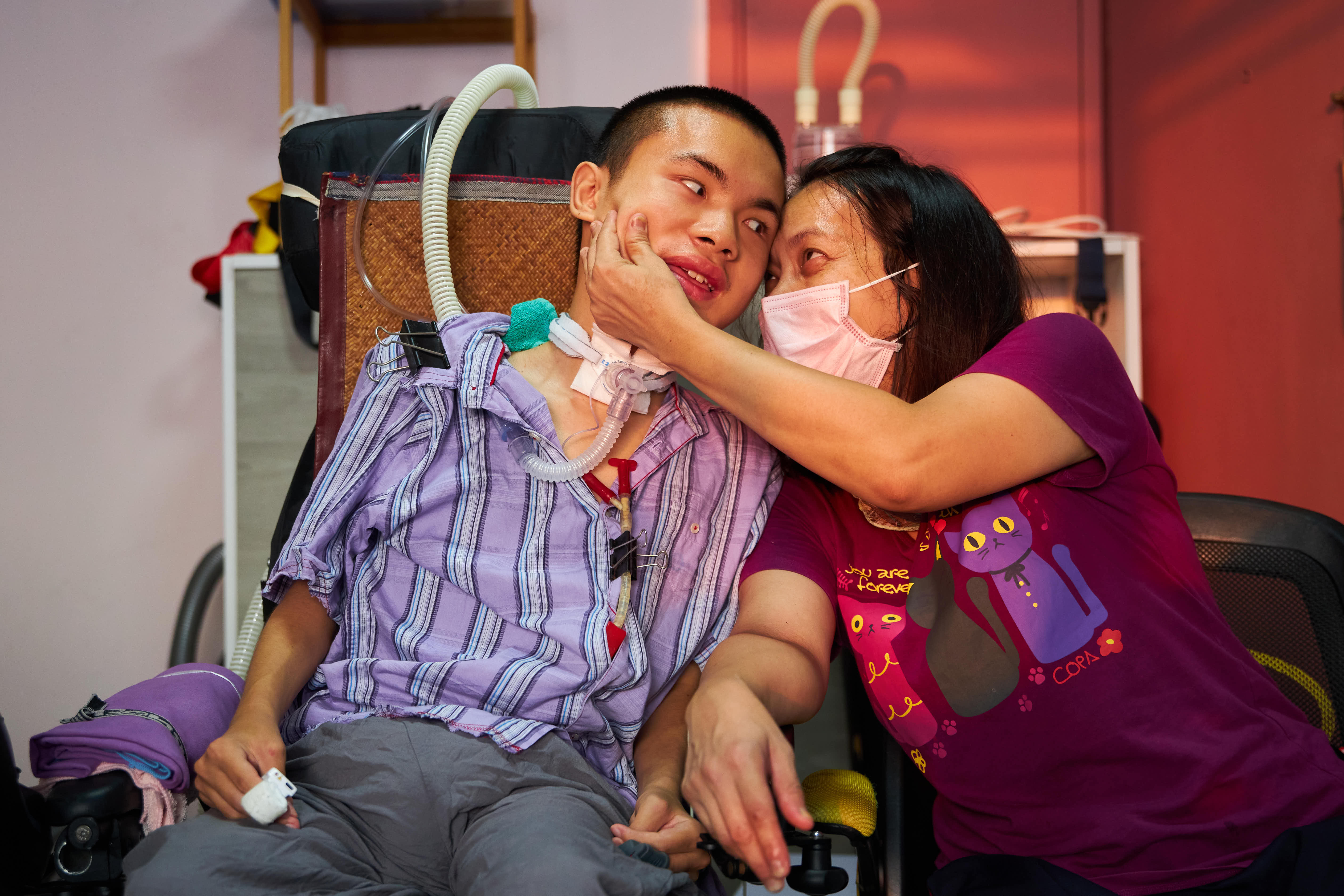
Upon entering the home, one can see Mrs. Yeung tirelessly preparing lunch for her son, scratching an itch, turning him over... Yeung Kwan-lam who suffers from Duchenne Muscular Dystrophy, is sitting in the living room, focused on his online class. On the adjustable desk are a tablet and a neatly handwritten copy of the Three Character Classic – despite his limited mobility, he insists on completing his homework stroke by stroke. Next to his "throne" are various life-sustaining machines, such as a suction machine, oxygen concentrator, and feeding tube. His mother meticulously recounts her daily routine of caring for Kwan-lam to the Lifewire team.
The average life expectancy for patients with this disease is only 26 years. At 22, Kwan-lam is considered to be in the late stages. Having crossed the threshold of death, he now relies on a feeding tube and ventilator, making even speech difficult. He can only nod or shake his head to communicate.


Rescue or Let Go? A Difficult Choice
"In November 2020, his blood oxygen was low, he couldn't breathe, it was very difficult. And I had never seen his neck so swollen while caring for him, so I immediately called an ambulance to the hospital. The doctor knew his breathing was poor, but because of the swollen neck, they couldn't use a ventilator until they found the cause. But then it still didn't work because he really didn't have enough strength to breathe... he was so thin, just skin and bones..."
Recalling Kwan-lam, who was then emaciated and weighed only 27 kg, his mother's eyes immediately welled up with tears. Even more heartbreaking was the need to decide her son's fate. "The doctor explained that in such a situation, it wouldn't work. Either insert a tracheostomy, or let him slowly stop breathing and pass away naturally..." To rescue or let go? It's a choice no one would want to make.
"I know you were breathing very hard (at the time), but you didn't have enough strength to breathe, did you? It was very painful, wasn't it?" Looking at Kwan-lam next to her, his mother still felt a chill of fear. "He breathed without a ventilator for two days in the hospital, and I knew he was suffering. Then, at around six that evening, he closed his eyes and wouldn't wake up no matter how much we called him. The nurses had to turn the oxygen up to 100% for resuscitation."
While his mother certainly couldn't bear to lose her son, she was also worried that he would only live in pain thereafter. Hesitating, she called the school social worker to understand the situation of other students with similar experiences after intubation. Unexpectedly, Kwan-lam's condition suddenly took a turn for the worse, his blood oxygen dropped lower and lower, and the nurse urged his mother to decide. In the midst of her internal struggle, his mother suddenly recalled Kwan-lam's words before he fell into a coma, "'I plan to live to be a hundred.' I knew he didn't want to die, so I decided to have him intubated." After waking up, Jun-Lam asked why he had a stoma. Mrs. Yeung explained that he would die if he wasn't intubated, and the sensible Kwan-lam immediately understood his mother's decision.


Witnessing His Body Deteriorate, Powerless to Stop It
"His legs are weak, the muscles in his calves are very stiff, and it's difficult for him to squat down. Climbing stairs is also very slow and strenuous..." Kwan-lam's symptoms had appeared since childhood, but due to a lack of public awareness about rare diseases, his mother initially mistook his calf muscles for being strong. When Kwan-lam was five or six years old, he was hospitalized with pneumonia, and doctors then diagnosed him with Duchenne Muscular Dystrophy, a condition with an incidence rate of only one in five thousand.
Over the next decade, Kwan-lam's body gradually deteriorated. "His walking, arm strength, leg strength, and even speech — he used to speak more fluently, but later on, it became like he had a stutter." Various methods, including exercise, physical therapy, and dietary changes, were tried, but all were ineffective. She could only watch helplessly as his functions continued to decline: "He didn't suddenly get much worse; it was a slow, gradual decline. I couldn't stop it..." Before she could finish, the kitchen alarm rang, and his mother rushed into the kitchen to boil traditional Chinese medicine – despite the slim hope, Mrs. Yeung never gave up, trying every possible way to alleviate his condition, just to let him live one more day.


Midnight Soup Brewing for Optimal Absorption
On the day of the home visit, the temperature was nearly 30 degrees Celsius, and the Lifewire team was sweating profusely, but his mother was happy that Kwan-lam was complaining about the heat. "Not long after he was discharged from the hospital, he needed suction every now and then. There was no fan or air conditioning, but he would catch a cold just by slightly moving. We once had to suction him continuously for two or three hours, almost none of us got any sleep!" Since Kwan-lam's discharge, Mrs. Yeung has been on 24/7 duty: fish soup, congee, Chinese medicine... racking her brains just to get Kwan-lam to absorb more nutrients. "When he was hospitalized, no matter how much soup and food I made for him, he wouldn't absorb it. His weight only dropped, it never went up."
Since then, his mother makes soup every morning, sometimes even preparing it the night before and waking up four or five times in the middle of the night to set the heat and time on the electric pot. "Mornings are when he absorbs best, so I try to give him the best food in the morning!" Watching his mother's meticulous creations, delivered drop by drop into her son's stomach via a feeding tube, Kwan-lam had finally gained some weight on the day of the home visit. "Recently, when he was in the hospital to change the tube, he weighed 35.6 kg, so I'm more at ease. The doctor previously said he was so thin he didn't have the muscle strength to breathe, so I hope he continues to gain weight!"
Besides suctioning phlegm and making soup in the middle of the night, sometimes when Kwan-lam makes a "squeaking" sound, Mrs. Yeung immediately wakes up from her sleep to smooth his clothes, not allowing a single wrinkle to make him uncomfortable. "I'm a light sleeper. My daughter says that with just a 'squeak,' I'm awake. I don't know how I do it."


Meeting Friends is a Pipe Dream; Stress Overload
His mother's sleepless care has come at the cost of her own health. Despite the hot weather, she wears a silk scarf around her neck; upon closer inspection, a lump the size of a ping-pong ball is visible.
Caring for a rare disease patient is something most people cannot comprehend. The combination of stress and irregular rest has led his mother to develop hyperthyroidism, which has progressed into a benign tumor. A troubled mind requires a spiritual cure; the endocrinologist also referred his mother to other departments for emotional counseling. "Initially, I was a bit resistant. Where would I find the time? But later, I decided to give it a try. The doctors and nurses comforted me after seeing me, allowing me to vent and have someone to talk to."
Mrs. Yeung frankly admits that the medication prescribed by the doctor has not helped her sleep. What she wishes for most is to meet friends, confide in them, and relax, but Kwan-lam's condition since his discharge makes it difficult for her to feel at ease. "Sometimes, even when I go grocery shopping in the morning, I rush back because I worry about the oxygen tubes loosening or detaching... these things have happened before." From Kwan-lam's discharge until the day of the interview, his mother has been by his side 24/7 for the past six months, never even going out for a meal. Her lunch on the day was just a piece of bread with peanut butter; sometimes she reboils the soup dregs from Kwan-lam's soup to eat. Going out for "tea and a bun" with friends is almost an impossible dream.


Hiring a Caregiver Encounters Price Increase; Hours Reduced Helplessly
His mother previously received temporary funding from the Hong Kong Muscular Dystrophy Association, which finally allowed her to hire a home-care worker to help Kwan-lam with tasks like wiping his body and suctioning mucus, alleviating some of her burden. "If anything happens, someone is there to watch the (suction) machine, so I can go buy groceries without rushing back frantically." Although his mother still tries to minimize going out, being able to rest at home or do some stretching exercises is a tremendous help to her.
However, the intermediary agency recently raised its prices, forcing them to reduce the hired hours. Moreover, the subsidy has a time limit, causing his mother to worry about the future. "Thirty-six thousand dollars a month is actually very expensive, not something an ordinary person can afford. I don't hire them for ten or eleven hours every day, so this number of hours wouldn't cost this much..." She considered a compromise, finding a foreign domestic helper to care for Kwan-lam, but an untrained helper would find it difficult to operate medical equipment such as ventilators and suction machines.
"Sometimes he can't make a sound, and even I, who cares for him regularly, might not understand what he means, let alone a helper?" For Kwan-lam, his mother is the person who understands him best. A glance, a "squeak," and his mother already understands and handles various issues for him. His mother also wishes to care for Kwan-lam herself, but her physical strength is limited, so she has no choice but to seek help from others. "That's why I sought help from Lifewire, hoping to hire a caregiver. Caring for him 24 hours a day puts a lot of psychological pressure on me."


No Matter How Tough the Road, They Motivate Each Other to Live On
"Kwan-lam, do you love your mommy very much?" Kwan-lam nodded at the team.
"Really? But you ask Mommy to do so many things, so demanding, you're working Mommy to death!" His mother spoke of how difficult it was, but behind her mask, a sweet smile was still discernible. She has always wanted to give Kwan-lam the best, but the pressure of caring for a child with a rare disease inevitably leads to arguments between mother and son. His mother slowly learned to let go of her emotions, and after a disagreement, she would explain her difficulties to Kwan-lam, cherishing their time together even more.
"At that time, I was very tense, everything was so tightly wound. I used to be even less accepting, but now I'm at least a little more relaxed, letting nature take its course."
As the interview drew to a close, the setting sun shone on Kwan-lam through the window. Before his hospitalization, Kwan-lam's wish was to travel to more places with her, hoping for a family trip to Japan. Now, even routine medical appointments require immense effort, taking almost two hours just to leave the house. Traveling seems like an unattainable luxury.
"Kwan-lam, do you really want to live?" Kwan-lam's eyes widened, and he nodded firmly in response.
"As long as you're here, I'll be by your side taking care of you. I'll do my best, okay?" His mother looked at Kwan-lam with a kind expression, and one could sense that although their initial choice was difficult, the mother and son would bravely and without regret continue on their path.
For Kwan-lam, his mother is the person who understands him best. With just a glance or a "squeak," his mother already intuitively understands and handles various problems for him. However, his mother's physical strength is limited, so she has no choice but to seek help from others. "I hope to be able to hire a caregiver to help. Caring for him 24 hours a day puts a lot of psychological pressure on me."


Please support Kwan-lam and Mrs. Yeung. You can make a one-time donation or monthly donation to help them through to the end of their lives.
Monthly Estimated Expenses
- Caregiver $8,000 - $40,000 (varies)
- Transportation for medical appointments $2,000
- Nutritional milk $2,500
- Soup ingredients, probiotics, and nutritional supplements $3,000
- Diaper inserts, protective mattress pads $300
Interviewer, Writer: Sio Hoi Chi, Leung Kim Hung
Editor: Leung Kim Hung, Avy Ip
Photography: Sea.Pho.Yea, Ken Mok
Video Production: Lifewire, Ken Mok, Sea.Pho.Yea
Life photos provided by the interviewee