
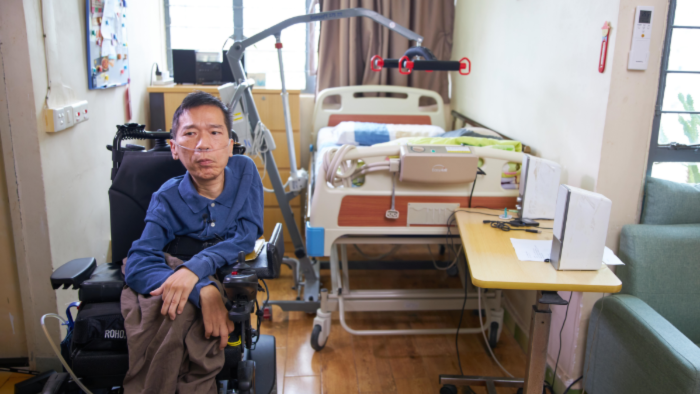
Polio Fighter - Li Wing-man
"Reni! (lifting his neck out)!"
A request for someone else to help him sit up so he could breathe properly,
was perhaps the most frequent phrase Lee Wing Man uttered in his life.
Confined to a wheelchair, his breath shallow; nearly sixty years old, but weighing less than 50 pounds;
Always with him were the oxygen-delivering "cat whiskers" on his face;
Without an oxygen concentrator, he couldn't even leave his home for follow-up appointments, and was almost on the verge of death;
Having suffered from polio since childhood, with only slight movement in his head and a few fingers, he was still willing to use his own story to inspire others;
"I don't need help my whole life. If I can do it, if I have the ability, I should help others!"


At 59, Wing Man is emaciated, resembling an eight or nine-year-old child. Polio has caused muscle atrophy, leaving him unable to control his limbs. He can only sit in a wheelchair for short periods, spending the rest of his time confined to bed. Lacking self-care abilities, his daily tasks are handled by Reni, his foreign domestic helper of 15 years. Even his urination and defecation require a urine bag or condom catheter.
Upon first meeting Wing Man, he appeared serious, not one to laugh easily, with an aura that commanded respect. However, once he began to speak, he shared his experiences volubly with the Lifewire team. While his illness restricted his body, it did not close off his heart.


Mother Believes Rumours, Misses Golden Treatment Period
"Babies need to burn up to grow tall and strong!" 1963 was the year Wing Man was born, and also the year Hong Kong introduced the oral polio vaccine. Although polio was prevalent in the 1950s and 60s, Wing Man's mother lacked medical knowledge and mistakenly believed neighbours' rumours, not taking his frequent high fevers seriously. "Back then, TVs weren't as advanced, so information spread slowly. When I was little, I drank condensed milk for breakfast, and my older brother ate plain congee with salt or brown sugar. We didn't know any better; we thought all kids ate these things!"
It wasn't until a high fever persisted for several days without improvement that his mother took him to the hospital, where he was finally diagnosed with polio. Although the doctor prescribed an oral vaccine, it was too late, and Wing Man showed no response to the medication: "It was too late! Those oral medications are for prevention, not treatment!"
Poverty hindered treatment, gradually losing mobility
According to the World Health Organization, approximately 0.5% of polio patients suffer lifelong paralysis, and 5-10% of these die due to respiratory muscle paralysis. Patients require lengthy treatment, but Wing Man's impoverished family could not afford the medical expenses, leaving him to "fend for himself." While other children played in parks or public housing estate corridors, Wing Man, unable to walk, could only sit by the doorway and watch.
"They didn't know I couldn't stand!" Wing Man recalled an accident when he was three or four years old. A neighbour tried to pull him to play, "and I fell straight to the ground, my head bleeding. My mom immediately stopped the bleeding and rushed me to the hospital."
As a child, Wing Man could still hold a bowl to eat and a badminton racket with both hands. At nine, he spent three years in the hospital. After being discharged, he could no longer walk independently and could only move forward by sitting on the ground and inching along. In his teens, to help support his family, he started assisting his mother with factory work, earning a few dimes. However, with the decline of Hong Kong's industry and his deteriorating health, he was forced to stop working. As an adult, he continued to rely on his family for support.


Gasping for breath even while sitting, purchases oxygen concentrator to survive
"Wait for me a moment, stop rolling." About ten minutes into the interview, Wing Man suddenly paused and asked Reni to help him catch his breath. Reni cupped his neck and chin with both hands, moving them up and down dozens of times like pumping a balloon. Wing Man explained that this helps him inhale more oxygen into his lungs, making breathing smoother. "Even now, I'm already out of breath, and they still tell me to go to the Jockey Club (clinic)." He sighed, lamenting that doctors didn't understand his plight: "I rely on an oxygen concentrator to breathe even at home. It takes three or four hours to go to the clinic for a follow-up. If anything goes wrong, the consequences are unimaginable..."
Recalling his first phone call to Wing Man, he said he had to hang up immediately and lie down to "prepare," as he couldn't talk for more than a few sentences while sitting. "I never thought I'd need oxygen; I never imagined I'd be like this today." Wing Man, with his "cat whiskers" on his face, spoke slowly, spitting out a few words at a time. His condition has worsened with age: in mid-2020, he couldn't breathe properly as soon as he put on a mask and couldn't sit for long, often needing to lie in bed to catch his breath. Six months later, he even had difficulty eating. "I'd rest for half an hour, then get up and eat again. At its worst, I'd have to rest four or five times." At that time, Wing Man was so thin that his cheeks were sunken in. "My face was pale, my lips white; even my mom was scared when she saw me!"
"The twice-monthly home physical therapy, twice-monthly occupational therapy, and home nurse visits... all stopped." Since the outbreak of the pandemic, many home rehabilitation services have been suspended, which also contributed to Wing Man's deteriorating condition. "If I can't eat, it means I'm waiting to die!" He realized the problem and bought an oxygen concentrator in March last year, slowly starting to eat again: "I can eat a bowl of congee sitting up now, instead of lying in bed." After being able to eat his favorite foods like shrimp dumplings and siu mai again, Wing Man's complexion improved, and his mood gradually recovered. However, even as rehabilitation services slowly resumed with the easing of the pandemic, Wing Man's body had not returned to its previous state.


Sudden short of breath, passer-by helps remove mask to save life
Wing Man used to go to the market with Reni or his mother to buy groceries, have dim sum, and get some fresh air. Last November, he was waiting for Reni in a shopping mall as usual, but he "suddenly couldn't breathe." In an emergency, he had to bite the bullet and go into a nearby bakery, asking a staff member to help pull down his mask so he could breathe deeply. However, the staff member flatly refused, only telling him to ask security for help. Luckily, another staff member spoke up in time: "Help him pull it down!" Only then was Wing Man out of danger.
"As soon as it was pulled down, I could breathe immediately." Wing Man still felt a lingering fear recalling the harrowing incident, but he dared not go out alone since then. "I told my helper, you go buy groceries, I'll wait in bed, I won't go out with you, it's too dangerous, I might not be so lucky to have someone save me every time." After that incident, Wing Man stayed at home for eight months, fearing the danger would repeat itself if he went out. But being confined to a small home, also made him feel suffocated. "No one can truly understand that feeling!" he said with a sigh.


Hospital check-ups unreliable, relapse the day after discharge
Wing Man had sought medical attention at the hospital due to breathing difficulties, but when the hospital checked his lung function, it was difficult to simulate daily life conditions: "When you're lying in bed, you have enough breath, and after a few deep breaths, your blood oxygen saturation is 93. They won't, and don't have the time to check you while sitting and lying down." After enduring three arterial blood draws, which Wing Man described as "painful enough to make me scream for help," he only received a report with normal indices.
The doctor ultimately concluded that Wing Man didn't need a ventilator and discharged him. "Time and again, they torment me like this!" He explained that the pure oxygen he breathed in the hospital was different from the oxygen concentrator he used at home, so he felt more energetic in the hospital. This made him think he was finally "cured," but to his dismay, the day after returning home, he relapsed and began gasping for breath again. "That's when I knew this illness wasn't so easy to solve."
Long journeys for follow-up appointments, hoping for a portable oxygen concentrator
Ever since he had to rely on an oxygen concentrator to breathe, Wing Man found it difficult to go out. However, every eight months, Wing Man has to attend specialist outpatient clinics, and general practitioner visits are every two to three months. Each follow-up appointment, including travel, takes at least three hours. The week of the interview, Wing Man was scheduled for a follow-up, but had to reschedule due to his inability to leave home.
"What I want most now is a portable oxygen concentrator." Breathing difficulties have limited Wing Man's life, keeping him confined to his bed and isolating him from the vibrant world outside. When asked about what he most desired to achieve, Wing Man frankly stated he had no other wishes than to stroll on the streets, take a walk in the park, or personally select his favorite foods at the market: "Just being able to go out is enough, I don't think about anything else. I can't even leave my doorstep now, so what else can I talk about?"

Chinese medicine effective, but difficult to afford, painfully abandoned
Seeing that Wing Man's condition didn't improve despite frequent hospital visits, his uncle gave him five thousand dollars to try Chinese medicine. After receiving Chinese medicine treatment, Wing Man's physical condition improved. "The medicine was very strong, and I felt some reaction after drinking it. I didn't notice much in the first month, but in the second month, I started speaking louder, and I wasn't as afraid of the cold; I felt less weak. Even the doctor said I was better." Although there were no further breakthroughs, his constitution was at least stronger than before.
"Five days of medicine, plus the consultation fee, cost five hundred dollars. It was a bottomless pit, so I had to give up treatment." His condition improved, but he couldn't afford the medical fees and felt uncomfortable asking relatives for more help. After the treatment was interrupted, he described it as a wasted effort: "It completely reverted to its original state, even worse than before."


Fearless of obstacles, he inspires himself and others
"I don't need help my whole life; those who can, those who have the ability, should help others!" Despite his disability and living on comprehensive social security assistance, his benevolent heart remains undimmed. While in the nursing home, the head nurse often invited him to speak at schools, and he also participated in performances promoting integration for people with disabilities: "At Ko Shan Theatre, performing a wheelchair dance, I was part of the finale." Once, he encountered an Indonesian domestic helper who had no money, and he gave her 100 dollars so she could buy a lunchbox to stave off hunger. Watching them express their gratitude repeatedly, Wing Man still remembers their genuine smiles.
Wing Man hopes to influence lives with his own. When students discuss family unhappiness, he encourages them: "No matter how unhappy you are, it will eventually pass. You can't live with your parents forever. Cherish the time you have together now, because once the opportunity is gone, it's gone." He does his best, hoping to use his experience to help students avoid detours and encourage them to cherish their loved ones!


Grateful for his nonagenarian mother's unwavering companionship, living in the present
"My mother loves to come over. She says that eating and chatting with her is what makes a filial son or daughter." Although Wing Man's condition worsened due to lack of treatment in his childhood, he didn't utter a single complaint throughout the interview. Instead, he expressed gratitude to his mother, who never abandoned him. During the pandemic, his mother, nearly ninety years old, disregarded objections from her other children and insisted on visiting Wing Man, and the two of them would go for walks together.
"On February 27th, she came to visit me, and on the 29th, she was diagnosed (with pneumonia). Sometimes, fate has its own plans; how can you avoid it?" The two, mother and son, in their later years, didn't want to leave any regrets. They overcame all difficulties to be together, and fortunately, his mother ultimately pulled through. "I told her not to worry so much; just come if you want to."
"It doesn't matter what others think of you, as long as you're happy." Wing Man accepts his uniqueness. The soft sunlight outside the window gently shines on him. He has no grand dreams; at this moment, Wing Man just wants to live in the present and spend the rest of his life with his aging mother.


Interviewers, Writers: Kei Wing Yan, Siu Hoi Chi, Leung Kim Hung
Editors: Leung Kim Hung, Siu Hoi Chi
Photography: Sea.Pho.Yea, Volunteer Jennifer
Video Production: Lifewire, Ken Mok, Sea.Pho.Yea
Personal photos provided by the interviewee