
Student nurse battles rare brain cancer with three recurrences - Ian Tso
Student Nurse Suffers from Rare Brain Cancer; Mother and Son Defiantly and Tenderly Push the Limits of Life
A 19-year-old nursing student, full of enthusiasm to help others, was struck by a rare brain cancer just as he was starting his journey. After enduring brain surgery, chemotherapy, radiation therapy, and a painful stem cell transplant, the cancer recurred twice. Following Gamma Knife treatment, the tumor miraculously shrunk significantly, but the targeted drug he needs is not subsidized, costing nearly HKD 140,000 per month. His mother sold all her family assets, but only managed to raise funds for the first month's medication. Fearing the loss of treatment hope, she urgently needs assistance from all sides.
Mother Quits Job to Provide Round-the-Clock Care
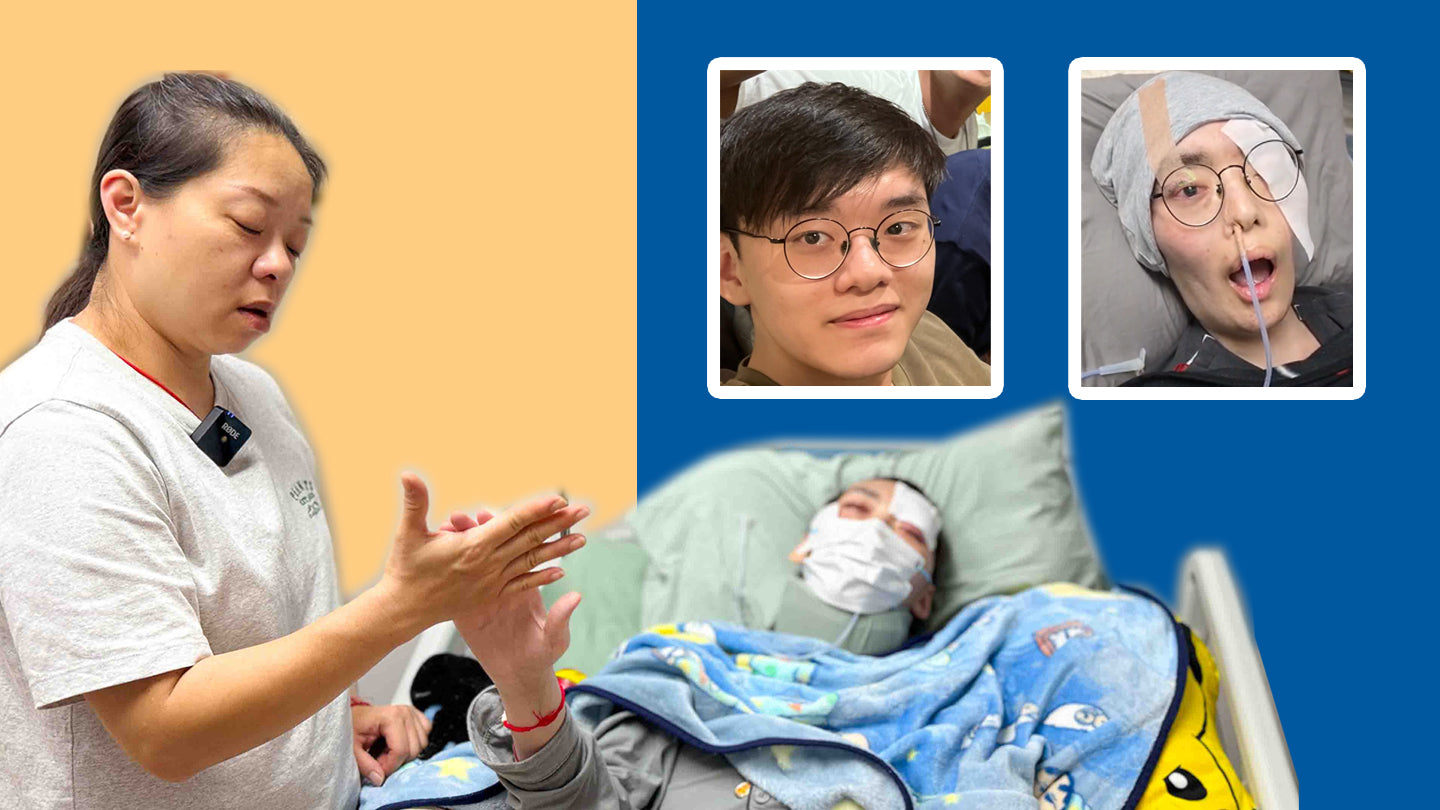
People often say the living room is the heart of a home, as it's where families gather and reflect their focus. In the home of Ian (Tso Yi Lok, 22), this space has been taken over by a hospital bed, symbolizing how the rare disease "Non-Germinomatous Germ Cell Tumor" (NGGCT) has occupied every breathing space and depleted every savings of the mother and son over the past three years. Yuki, who quit her job to care for her son full-time, rests on the floor beside his bed at night to provide 24-hour care.
Ian, thin with sunken cheeks and frail, has been mostly bedridden recently. He plays video games beside his mother during the interview; in the summer heat, he needs to be covered with layers of blankets and wear gloves to stay warm in the 24-degree air conditioning. "I just want him to play games. If he doesn't, it means something's wrong!" This ordinary daily routine for a young man is something his mother is grateful for.
The feeding machine on the table, the piles of medicine, and the IV pole by the bed silently bear witness to this battle against cancer.


From "Aspiring Nurse" to "Critically Ill Patient"
Yuki, who has worked in the healthcare industry for many years, describes her son as being exceptionally sensible since childhood. Seeing how hard she worked, he would conscientiously study, maintaining grades above 80. In secondary school, he also worked part-time at a nearby restaurant, hoping to ease the family's financial burden. Although he achieved excellent results in the DSE, enough to enter a top-tier university, after witnessing his mother's meticulous care for his grandmother who suffered from esophageal cancer, he aspired to care for patients and chose to follow his mother into the healthcare profession, enrolling in nursing school.
"And for money," Ian, with a faint voice, managed a hoarse yet humorous remark. His mother chuckled, saying, "He always said, 'I'll finish sooner, earn money sooner.'"
What surprised his mother even more was that Ian had learned fluent Japanese by watching anime and acted as a translator when traveling to Japan with his classmates, meticulously caring for everyone, earning him high praise as a warm and thoughtful person.
Fate, however, turned this warm-hearted "aspiring nurse" into a "critically ill patient" who now needs care. "If he were a naughty boy, it wouldn't hurt as much, but he isn't," his mother said with a bitter smile.


"Nothing serious" suddenly turns into "last goodbye?"
The story began with a common urban ailment—a headache. In mid-2023, after finishing Year 1, Ian suffered from headaches so severe that he finished an entire box of painkillers in less than a month. Coupled with slow eye movement, even strabismus, and excessive sleepiness (sleeping 16 hours a day), his mother took him to various doctors for over three months. Just before the new semester was about to begin, they went to the emergency room for MRI, CT scans, and blood tests. The doctor initially said there was nothing serious and advised them to go home and observe. Fortunately, his mother, relying on her medical experience, insisted, and Ian was admitted for observation.
His mother received a call from the hospital during the five-minute drive home: "They said he (Ian) had severe hydrocephalus and needed immediate brain surgery. They couldn't wait for me to sign the papers, otherwise his life would be in danger at any moment!" At that moment, she plummeted from the illusion of her beloved son being "fine" to the abyss of "last goodbye?"
Full of questions yet utterly blank, only a sliver of hope remained in her heart. She immediately contacted Ian's nursing school classmates and teachers. Even his homeroom teacher rushed over after hearing the news, hoping to cheer on this good student and classmate.


Three Relapses: A Rollercoaster That Never Stops
After the hydrocephalus surgery, doctors discovered a tumor in Ian's pineal gland. Blood tests revealed it was a dangerous "non-germinomatous germ cell tumor" (NGGCT) – a rare disease more common in Asian patients, with only one or two cases per year in Hong Kong. His mother's mood plummeted like a "rollercoaster" to rock bottom.
Faced with an extremely rare cancer where data is insufficient to support new therapies, only traditional methods can be employed. Ian underwent chemotherapy, then another brain surgery, but unfortunately, the tumor was adhered to a major vein, allowing only two-thirds to be removed. Afterward, he received very high-dose whole-ventricle radiation therapy.
After a year of treatment, his health slightly improved. Just as Ian was happily preparing for school to start in September, the MRI report cruelly announced: "Relapse and metastasis." Cancer cells were found in his spine, so doctors opted for high-dose chemotherapy, whole-spine radiation therapy, and a stem cell transplant. The process was agonizing, like being in hell—oral ulcers, severe bloody diarrhea, rashes, delirium...
After a year of rest, they thought he could finally go back to school, but "the doctor suddenly called again and said, 'Mom, he can't go back to school.' I asked, 'What's wrong now?' 'The cancer is back in his head.'" This diagnostic "rollercoaster" seemed to never stop.
A Dramatic Helping Hand from the Abyss
Ian experienced strabismus and severe headaches again. This time, the tumor was aggressive, pressing on his brain and nerves, causing his physical functions to rapidly deteriorate. From being able to "walk and move," he became unable to open his eyes due to drooping eyelids, couldn't swallow, had convulsions, and his limbs were immobile, almost paralyzed. Public hospital doctors were helpless, stating that Ian was too weak for further treatment and that he had only weeks to live.
"I knelt with him (my son) at the hospital entrance, not knowing what to do," she recalled. "Suddenly, a business card fell out of my bag – it was a Gamma Knife card." This was from a Gamma Knife seminar they had attended together before her son fell ill. This dramatic turn led his mother to seek help from Dr. Ho Ting Kwok, founder of the Gamma Knife Charity Foundation.
The next day, Dr. Ho immediately performed an MRI on Ian and found the tumor was as large as a golf ball, a whopping 46cc, stating the risks were very high. He held Ian's hand and asked, "Do you want treatment? If you do, I'll try with you." At that moment, Ian found an unknown strength and gripped Dr. Ho's hand tightly, nodding vigorously. Touched by Ian's will to live, Dr. Ho immediately consulted with foreign medical experts, and the "Gamma Knife" treatment began the following week.
Three weeks later, another MRI showed that the tumor had miraculously shrunk significantly to 3.6cc, the size of a soybean, almost invisible to the naked eye. His mother said this was the first medical case of its kind without surgical intervention and would be documented in literature.


Is the Value of Life Defined by Money?
Ian now requires targeted therapy, and his physical functions and health indicators are gradually improving. However, the drug is not government-subsidized, costing nearly HKD 140,000 per month. The mother and son have been relying on Comprehensive Social Security Assistance (CSSA) for the past few years, having sold all their assets, including special edition antique wines cherished by Yuki's late mother, borrowed money from relatives, and received donations from kind-hearted individuals. Yet, they only managed to raise funds for the first month's medication, fearing that the inability to buy medicine will extinguish the glimmer of hope.
"Does life really have to be measured by money, bought with money?" Yuki asked helplessly.


Improved after Targeted Drug Therapy
Ian's spirits improved after the first month of targeted drug therapy. Although his eyelids still droop and need to be taped open with medical tape, he has miraculously gone from almost completely paralyzed to being able to play video games for several hours and pull himself up by holding onto the overhead bar on his bed.
Yuki also carefully prepares meals for her son, blending food into a paste for tube feeding, hoping Ian will absorb nutrients well to fight the cancer. When her son rests and sleeps, she seizes the time to record every treatment and medication, search for information and literature online, look for treatment methods, and even write letters to foreign organizations for help.
Her persistence stems from regret — she blames herself for not being able to care for her deaf and intellectually disabled younger brother when she was young, and for not being more filial to her mother who suffered from esophageal cancer. Facing her son, she cannot, and will not, allow herself to have any more regrets.
Some friends, and even doctors, advised her to "let go," but what others misunderstand as "selfishness" is actually a different kind of great love.
Perseverance is to Help Her Son Realize His Dream
"A rare disease is not a terminal illness" is a statement made by Ian and put into practice by his mother. "If 'rare disease' and 'terminal illness' were the same, there wouldn't be two separate terms."
Different doctors asked Ian the same question: "What is your unfulfilled wish?" Yuki replied, "It's to try new medications. He said he'd try them even if it killed him." He said, "'I want to help people, I can take it,' and 'I'll try it. If it doesn't work this time, I'll try again next time.'"
"At least the next person won't have to go through what I did, taking many detours in treatment; the previous path was very difficult." Even while suffering from his illness, Ian still wanted to help others.
"He said that even if he couldn't continue studying nursing now, he found another way to help people." This was by trying medications himself and pioneering new treatment methods.
Having personally experienced the challenges of seeking treatment for a rare disease, often encountering a lack of data and inability to use certain therapies, "my son firmly believes that 'everything starts from zero data; if there isn't any, then create the data.'" Just like he validated the efficacy of Gamma Knife surgery.
"With the literature from his treatment, the next patient can undergo Gamma Knife treatment on the first day, avoiding all those surgeries, radiation, and chemotherapy. Then, using this targeted therapy, it won't be as difficult."


"There's always a way out!"
Lifewire asked Ian what he wanted to do after recovery. He weakly uttered three words: "Go traveling." He also made an effort to say, "There's always a way out!" and praised his mother, "You're amazing." His mother's heart was instantly healed by his immense tenderness.
"As long as we're together, nothing is a problem." The mother and son's wish is simple: to be with each other forever.
Interview and writing: Chan Yin Lam, Chan Wai Ki, Leung Kim Hung
Editing: Chan Wai Kei, Leung Kim Hung
Narration: Leung Kim Hung
Photography: Sea.Pho.Yea, Mak Chiu Yuk
Video Production: Lifewire, Sea.Pho.Yea, Mak Chiu Yuk
Interview Date: June 2026
|
Gamma Knife Creates Miracles: Persistence from the Will to Live |
|
"Although he went through so much painful (treatment), Ian's will to survive is very strong, and his mother Yuki's dedication is also immense; it's almost like... Yuki's life was given to Ian." Dr. Robert Ting Kwok Ho, Medical Director of the Brain Centre and Gamma Knife Centre, was moved by the strength of Ian (Tso Yi Lok, 22), a nursing student suffering from a rare brain cancer called non-germinomatous germ cell tumor (NGGCT). He decided to take a chance and perform Gamma Knife treatment on him. He still vividly remembers when Yuki brought Ian to him for treatment in September 2025.
Ian's strong will to live, with maternal love as his greatest support Dr. Ho stated that Ian's condition was already very serious at the time. "We measured the tumor's volume, and it was about the size of a golf ball, which is very large for its location near the brainstem. It was already pressing on the brainstem nerves." Ian's eyelids were drooping due to pressure on the third cranial nerve, making him unable to open his eyes; his limbs were almost paralyzed, and he had difficulty speaking. "But his mind was very clear. When we asked questions, he often had to hold our hands to answer 'yes' or 'no', and if 'yes,' he would squeeze harder." Dr. Ho said that Ian had undergone many painful examinations and treatments since 2023, including chemotherapy, radiotherapy, and bone marrow aspiration, but he was not defeated. "His will to live is very strong." Coupled with his mother Yuki's 24-hour care and her efforts to secure funds for medication, she poured all her energy and time into her son. "She is truly amazing," said Dr. Ho. A Medical Miracle: from 46cc to 3.6cc "(At that time,) we told Yuki and Ian that the chance of successful surgery was fifty-fifty, but they had already decided to proceed regardless of the risks." Ian then used all his strength to tightly grasp Dr. Ho's hand and nodded vigorously, and this firm will to live touched Dr. Ho. One month after completing Gamma Knife treatment, Ian's tumor volume shrank from 46cc to 3.6cc, almost imperceptible to the naked eye. "We were very surprised to see such results in such a short time," Dr. Ho said. Even more gratifyingly, Ian's physical functions gradually recovered; his hands could now play video games and use the computer, and he went from being unable to speak to being able to say, "There's always a way out!" However, Dr. Ho pointed out that the non-germinomatous germ cell tumor Ian suffered from is very aggressive and can spread through the cerebrospinal fluid, so it needs to be treated with other oncology treatments such as targeted drugs.
The Invisible Blade of Radiology - Gamma Knife Gamma Knife is not a physical surgical knife, but an advanced stereotactic radiosurgery instrument. It uses about 200 gamma rays from a Cobalt-60 source, precisely focused by collimators onto a fixed point called the "isocenter," making the treatment painless. "This isocenter doesn't move; instead, the patient's bed is moved to align with the isocenter's position, allowing the tumor to receive treatment," Dr. Ho explained. Compared to traditional radiotherapy, Gamma Knife has relatively weaker energy, but its "weakness" is precisely its advantage, as it has less impact on normal cells. Taking Ian's case as an example, he was very weak at the time. If traditional radiotherapy had been used, the affected area would have been much larger; however, Gamma Knife can focus radiation more precisely on the tumor, and the radiation dose is much lower. Establishing a fund because too many people are "at their wits' end" Despite the many advantages of Gamma Knife, Dr. Ho frankly stated: "This treatment is truly quite expensive." The government used to refer over a thousand patients to them through the Samaritan Fund. However, in the past decade or so, the number of referrals has significantly decreased. Many patients in need are unaware of this treatment method or that they can apply for assistance. Witnessing patients giving up on Gamma Knife treatment due to financial burdens, "we felt that there was a need for such a charitable fund." He and his team then established the "Gamma Knife Charitable Fund" to help financially disadvantaged patients receive treatment—this was his original intention. There is hope, but people don't know it. Dr. Ho admitted that most Hong Kong people are not very familiar with Gamma Knife. The foundation has intensified its publicity efforts and organized seminars in recent years, which has indeed led to more patients learning about them. However, he shook his head and said, "It's still not enough." Many patients and their families simply do not know that they have this option. He believes one significant reason is the lack of introduction and promotion by public hospitals, making it difficult for the public to access information about this technology. However, the situation has recently taken a turn, with the Hospital Authority set to install its first Gamma Knife unit in November. He hopes that once the Gamma Knife in public hospitals is operational, more patients like Ian will be aware of this option sooner, instead of having to wait until they are at their wit's end, with their options literally falling out of their pockets, before realizing they have a choice. He hopes that more lives will be saved as a result. "To let more people understand the uses of Gamma Knife." This is Dr. Ho's purest wish.
Acknowledgement: The Brain Centre and Gamma Knife Centre Interview and writing: Chan Yin Lam, Elaine
|


