Drawing Untraveled Landscapes with Three Fingers - Tse Cheuk-yau
YY, who can only move a few fingers on her entire body, often surprises people with her witty and inspiring answers. After she was diagnosed with the illness at one year old, her parents worried about how to help her navigate life. However, as they journeyed together, it turned out that their daughter was leading them every step of the way.
"Many children run around and bring joy, but YY brings joy with her mind," her mother said.


Only three fingers have strength
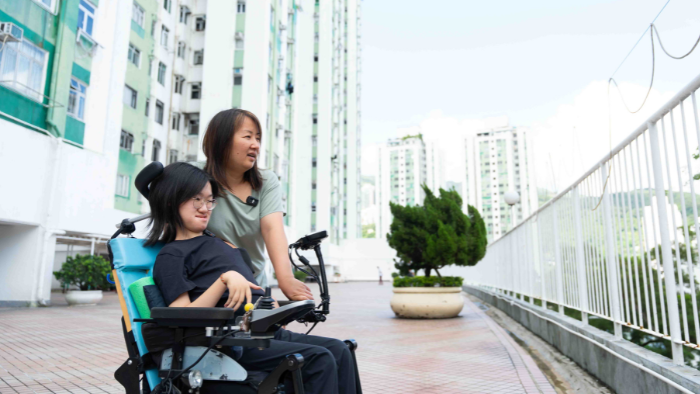
Tse Cheuk-yau (YY, 16), slender and with only three fingers on her right hand and slight movement in her left, listened from her wheelchair as her mother was interviewed. Sometimes her eyes widened, other times she glanced sideways at her mother. "She often expresses herself with her eyes. People with SMA express everything they want to say with their facial expressions and eyes."
What is not apparent, however, is that while YY may seem fragile, her inner strength is immense. Spinal muscular atrophy often confines patients to wheelchairs, but she is determined to break free, turning her wheelchair into her legs to explore the world.
Her mother said that YY was like any other baby at birth, until she was over four months old and could no longer roll over. She initially thought it was just a developmental delay, but when YY still couldn't sit up at nine months, her mother knew something was wrong and sought medical help everywhere. "A doctor suggested a brain scan first. After the MRI, they told us her brain was fine, and we were so happy that day." Just when they thought they could breathe a sigh of relief, the hospital report brought even worse news. "The report came out exactly on her first birthday, confirming she had Type II spinal muscular atrophy."


Uncertainty about the future
Anxiety before diagnosis, collapse after diagnosis. "At that time, all hope was lost. I didn't know how to proceed, nor how to help my daughter walk this path. I had never even heard of this disease." Desperate for a cure, they believed everything they heard—that one divine doctor was good, that acupuncture was effective. They would rush to try anything. "People said everything would be fine after praying, or changing her name, or having her adopted by a Guan Yin. We believed it all," she said. "I was crazy then because I hadn't accepted the fact, and my mind was in chaos."
She also complained and cried, "Out of over 7 million people, only about 60 have this disease, and I never win the lottery." Unwilling to face her daughter's condition, her mother once immersed herself in work to numb the pain. But her daughter's growth, progress, continuous skill unlocks, and every surprising and touching moment made her parents rediscover their daughter. "Since she started first grade, I realised it wasn't so bad. YY could do anything."
"When she first learned to use an electric wheelchair, she drove so well," and "In first grade, she participated in boccia at school and won second place in a competition." YY also showed artistic talent in painting. Her mother was amazed that she could create palm-sized works with just a few fingers, and some of her paintings were even selected for a competition in the United States and featured in an exhibition.
"It turns out that God takes some things away but gives her other abilities. The fact of her illness is right before us; it's up to us how we want to proceed."


Two near-death experiences "woke up" her parents
But no matter how one chooses to proceed, health issues remain a constant threat. Spinal Muscular Atrophy (SMA) affects patients' lungs and respiratory function, making even eating or pneumonia potentially life-threatening. Hospital visits are routine, and YY once relied on a ventilator for over two months due to pneumonia, teetering on the brink of life and death.
When she was in first and second grade, she also couldn't eat due to lung problems, and doctors suggested a gastrostomy. "If we didn't do the surgery, she would die; if we did, she might also die. Her limbs were already immobile; we didn't want her to lose the ability to eat too."
Her parents stood at a crossroads of fate, and YY's words, "Daddy, when I can't eat anymore, then you can do it for me," awakened them. It wasn't the worst-case scenario yet; "we'll deal with it when I can't eat." Fortunately, YY's swallowing ability gradually recovered, and she didn't need a gastrostomy. She was like a beacon, not only illuminating her own path but also guiding her parents' way forward.
The path to fighting the illness is not smooth, but YY and her mother believe it is not a dead end. As she grows, YY will need to face one of the major risk surgeries for SMA patients—spinal surgery.
"Actually, no parent wants to push their child into an operating room; we really didn't want to." But because her lungs were compressed, hindering breathing, and as she grew, her spine would become increasingly rigid, making the risk higher. In the end, at 13, she couldn't avoid the 8-hour surgery.


A different childhood, a different kind of joy
YY only remembered the intense pain for more than two months after the surgery. "YY was a bit emotional, and seeing her unhappy but not speaking out worried us greatly." Her mother's heart ached. During the pandemic, only one person was allowed to stay with her in the hospital. Although a domestic helper stayed overnight, YY couldn't help but ask her mother, "Mommy, can you stay?" So her mother "snuck in," held YY's hand to comfort her, and they spent a warm night together.
"What's up?" YY, who was beside them, couldn't help but interject, "Yes!" Her mother quickly replied, full of spirit. During the interview, her mother did most of the talking, with YY occasionally adding comments. "Why does it seem like you're only interviewing me? You should say something too!" The mother and daughter bantered like a squabbling but affectionate pair. "You're speaking very well, keep going." YY responded in a "world-weary" tone, typical of young people today, making her mother laugh helplessly.
"People with SMA are very smart, not simple; they think faster than us." This cheerful member of the family often bantered with her mother. "In first and second grade, I was teaching her homework, and she just couldn't get it. I got so frustrated and wanted to grab a clothes hanger [to hit her], but then she said, 'Calm down first,' and I laughed, and she was fine."
"She always tells me I'm annoying now," her mother said. "I worry about her going out alone, but she feels capable. She's always been very confident and even asked me, 'Don't you trust your daughter?'"


Wheelchair does not hinder her pursuit of idols and dreams
Her mother learned to let her daughter grow up, allowing her to go out with friends to shop, eat, and watch movies, and to plan activities herself by researching online. As a fan of MC Cheung Tin-fu, YY also pursues her idols with like-minded friends in wheelchairs, attending MC Cheung Tin-fu's concerts and street performances. Her loving father tries his best to drive her there and pick her up, waiting nearby, while her mother checks the live situation online, watching over her daughter. Her mother looked at YY and said, "The most important thing is that she's happy."
YY, who jokingly says she loves "eating, drinking, and having fun," has a clear mind and strong opinions. For example, when she participated in a boccia competition as a child, she only told her parents after reaching the finals. Besides enjoying anime, gaming, and watching YouTube like many other teenagers, seeing the world from home, she also taught herself drawing. Because she admired the work of an artist on Instagram, she contacted them to learn painting, and her artwork can be seen everywhere in their home.
She uses watercolors to depict lighthouses by the coast, a scene YY has never visited. "It's a way to pass the time because once you start painting, you don't know how long it will take, maybe one, two, or three hours." Her mother, knowing her daughter's temperament, has always let YY choose for herself. "We've never forced her to do anything."


"I'm used to it, don't mind them."
YY has always had her own ideas since she was a child. Even though her body is confined to a wheelchair, her heart has always been open. Her mother remembers that when YY was little, other children on the street often stared at her with curious or sympathetic looks, but YY didn't take offence, saying, "I'm used to it, don't mind them." She also encountered an elderly passerby who asked, "You're so old and still in a wheelchair, can't you walk?" YY and her mother could only smile helplessly.
"When I was little, I thought, it's hard for people with illnesses like us to make friends with 'normal' people. Even if we do, are they sincere? Maybe they're just being superficial," she said. "If you want to make friends, you wouldn't choose someone in a wheelchair who needs help and can't take care of themselves."
But for her, the wheelchair is part of her body. When discussing lunch with her mother, she would wiggle control stick, making her wheelchair sway back and forth as if "pacing." When the interview went on for a long time, she would raise and lower her wheelchair to change her posture. Finally, when she could relax on the building's platform, YY would control her wheelchair to "stretch her muscles," sometimes circling, sometimes speeding straight ahead, prompting her mother to chase after her and remind her, "YY, don't go so fast, be careful not to hit anyone." Moving forward without hesitation, perhaps YY knows her direction very well.


HK$160,000 for a wheelchair, an additional burden
YY's freedom depends entirely on this electric wheelchair, which she has used for over ten years and was modified according to her health condition. Each repair costs thousands to tens of thousands of dollars, but some parts are no longer available, making future repairs impossible. A new electric wheelchair, including modifications, costs HK$160,000. Coupled with a 80-90% drop in her father's used car business in recent years, even with her mother working full-time, purchasing a wheelchair is a huge expense.
Additionally, the annual cost of spinal muscular atrophy medication, originally HK$1.6 million, still amounts to tens of thousands after government subsidies, along with expenses for a suction machine, ventilator, four physical therapy sessions per month, and health supplements, placing an immense burden on the family.
The journey is difficult, but her mother is grateful for the many people who have helped along the way. "Everyone's path is different. We've gotten used to taking care of her; it's harder than taking care of ordinary children. But looking back, nowadays parents are like tiger moms, and I don't have that pressure. I only ask for her good health, and that makes me very happy."


Cherish the present, live every moment well
People often look to an unknown future, overlooking the beauty of the present. YY's presence changed her parents: they no longer rigidly control and plan for the future, but take things one step at a time, living in the present. Perhaps the present moment is the happiest.
As the wheelchair moved forward, the wind blew her hair, like flying wings—wings woven from confidence, strength, and her parents' love.


Interviews, writing: Chau Tsz-wing, Chan Wai-kei, Leung Kim-hung
Editing: Chan Wai-kei, Leung Kim-hung
Photography: Ken Mok, Sea.Pho.Yea
Video production: Lifewire, Ken Mok, Sea.Pho.Yea