
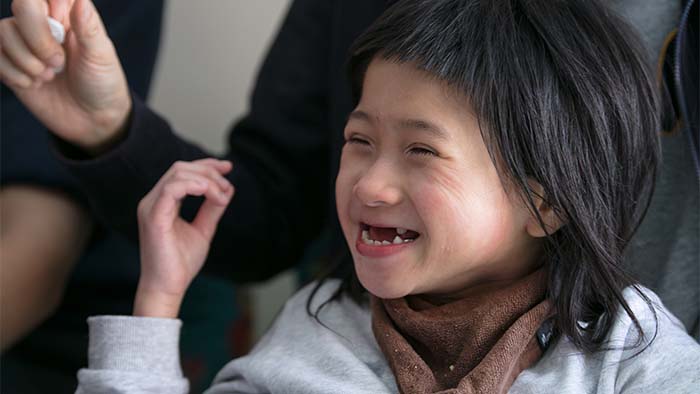
Angels Who Never Grow Up - Chan Wing-ning
"My name is Chan Wing-ning, I'm 8 years old. I love to smile, I love to laugh, and I love my mom, dad, and little sister..."
These are words that cannot be spoken, but perhaps they are the innermost thoughts her parents long to hear;
She loves to grin, but cannot speak;
She has all her limbs, but cannot care for herself;
Angels evoke both pity and fear because they are rare and incurable, leaving people helpless;
Little angels, fearless, descend to earth, unfolding extraordinary lives for ordinary couples.
"If she could just nod in response, feed herself, go to the toilet, and put on her shoes... I would be overjoyed!" Eight-year-old Wing-ning cannot speak, cannot care for herself, and has severe intellectual disabilities... She often laughs without reason, and even drools, simply because she cannot control her oral muscles.
This family of four is not shrouded in gloom; they have not been defeated! The birth of their little angel eight years ago brought her parents the happiest six months of their lives. After that, their trials began...


Needles All Over Her Head, Parents Cry Together
"We had all the pre-marital and prenatal check-ups, the baby was full-term, and everything was normal." Unexpectedly, when Wing-ning was 7 months old, the Maternal and Child Health Centre found that she had strabismus and couldn't sit upright, becoming especially anxious around strangers. Doctors suspected a problem with Wing-ning's brain, which her mother, Joe, frankly couldn't accept. "She's so lively and always smiling, there's nothing wrong. She just sleeps poorly and doesn't eat well; maybe we're just new parents who don't know how to take care of her."
Ultrasounds, brain scans, bone marrow extraction... "Every day when I came home, I'd see a dozen business cards on the table, telling you which famous doctor was good, which practitioner was good. We'd try anything. Traditional Chinese medicine, acupuncture, chiropractors, physical therapy, occupational therapy..." Wing-ning has been to countless clinics. "Not counting private doctors, just follow-up appointments covered six or seven specialties."
"We took her for acupuncture when she was 8 months old. Her head was full of needles for 40 minutes, and my husband and I cried for those 40 minutes." The couple often sought medical attention only to be turned away, achieving nothing, constantly oscillating between hope and disappointment.
After more than a year of hardship and contradiction, DNA testing finally confirmed Angelman Syndrome. "Watching her developmental curve fall further and further behind," her father Joson recalled, "it was a long, anxious, painful... process."


"Holding My Daughter Like a Madman, Crying for Help"
Even with a diagnosis, they couldn't relax. "There was one time she suddenly had a high fever, soaring from 30 to 40 degrees in 10 minutes. On the five-minute drive to the clinic, she collapsed and fainted. I rushed into the mall, holding my daughter like a madman, shouting for help."
Seizures are common in individuals with Angelman Syndrome and are often the most distressing for parents. "Eighty to ninety percent of patients will have seizures. When she has one, there's nothing you can do, but the most important thing is to ensure her safety and see if immediate first aid is needed." Joe explained that seizures can also cause a loss of skills. She gave an example: "She could feed herself, but after a seizure, she regressed and couldn't do it anymore. She was trying to use the toilet, but after one seizure, she refused to sit on it again. She still won't sit on it now, and that was four years ago."


Uncontrolled Self-Harm, Head-Banging
However, there is currently no cure for this condition, and treatment and training primarily focus on improving the patient's daily life. In addition to constant, meticulous care, special attention must be paid to the little angel's emotions. "She has the intelligence of a 2 or 3-year-old. When she can't express what she wants or can't do something, she loses emotional control!" Wing-ning's usual tactics to make her parents comply include lying on the floor, hitting herself, and self-harm, eventually getting her way. Joson explained that she has a low pain threshold and will only stop self-harming when she bleeds or experiences severe pain. "She's very stubborn and forgets herself when she resists."
During the interview, Wing-ning, who had been laughing joyfully, suddenly threw a tantrum and cried loudly, then started banging her head against the wall with loud thuds. However, we couldn't help because we truly didn't know what she was thinking at that moment.


One Year of Caring for Her, Ten Years of Aging
To care for Wing-ning, the entire family had to move, and Joson endured many sleepless nights, leading to problems with his immune system and a host of illnesses. He once suffered from a stomach hemorrhage, which shocked his doctor: "Wow! How did you endure such pain? You need a blood transfusion immediately; you're anemic and need to be hospitalized immediately." But Joson refused: "No, I have to pick up my daughter from school; I can't go to the hospital!" In the end, he had to take medication to alleviate his condition first.
Soon after, he developed facial paralysis and carbuncles. Although they believed in the slow, restorative methods of traditional Chinese medicine, when caring for Wing-ning, "No! We can't be slow! So we took Western medicine aggressively. Quick! Speed is the most important thing, doctor!" This super dad couldn't help but sigh, "One year of caring for her has aged me ten years."


"What Did I Do in My Previous Life?"
"What did I do in my previous life?", "She's here to collect a debt," "Cheating people, feigning misery, taking advantage"... Wing-ning's illness certainly consumed her parents' energy, but the unkind stares and harsh criticisms from others were equally piercing. Some families with sick children even choose to hide, afraid to reach out for help.
Despite the chilling words, Joson and Joe remained positive and never avoided the situation, accepting their little angel completely. Joson believes that no one likes to be looked down upon, and he wouldn't underestimate his daughter either. "If you care about what others think of your daughter, and even you yourself care, how will your daughter feel?"
"Every family has its own problems; some children are more capable, some less. The most important thing is that we, as a family, walk this path together, no matter the circumstances. Nothing is more important than our family being happy and whole!"


Sister Arrives, Life Returns to Normal
While Wing-ning's diagnosis was still pending, Joe unexpectedly became pregnant with their second daughter, Cherry. "I might not even be able to take care of one, what will I do?!" They were even more worried that the strange illness might strike again. After much struggle and testing, the couple finally overcame their psychological barrier and decided to let nature take its course. Fortunately, the arrival of their younger sister injected a strong dose of confidence into the entire family, bringing a lot of positive energy.
However, Wing-ning also influenced her sister's growth to some extent. Cherry was not consciously aware that her older sister was different and even imitated her. "She once went a whole year at school without speaking a single word because her sister didn't talk." The two sisters would also occasionally stage "Daddy battles" for attention. For example, when traveling, her sister would say, "You held my sister for four days; you held me for four minutes. Do you remember you still have another daughter?" This left Joson and Joe both laughing and crying.
Later, as her sister grew more sensible, she began to cooperate with Wing-ning and became very protective and loving towards her older sister. "When we went out with her, some of the judgmental looks from bystanders, or unfriendly remarks towards her sister, would make her very angry and emotional... it would affect her, and also impact the child's psychological well-being."
The couple is very grateful for Cherry's arrival, which transformed a family that was previously confined to a small community into a family of four venturing into the normal community. Joe's parenting mindset has also changed significantly. She admits that when she first became pregnant with Wing-ning, she had many expectations and imaginings, and the moment she learned something was wrong, it felt like a bolt from the blue, sending her spiraling to rock bottom. Joe describes raising Wing-ning as experiencing a storm, so her attitude towards her second pregnancy had already shifted. "No demands, no elaborate plans. Things that should have been stressful felt very calm; we just let nature take its course."


Don't Let Disability Stifle Activity
"When in Rome, do as the Romans do"; despite the difficult days, they learned to let go. This calm acceptance did not come easily. Initially, Joe could not accept the facts. "I'd cry even while working. I'd never even heard the name of the illness, there was no cure, she would never get better, she'd be like this her whole life!" To her family, she would only explain this heavy matter with understatement. "You could hear that she didn't dare to be sad, but you knew she was very sad." Joe was devastated at the time and very withdrawn, let alone telling others. Later, she gradually opened up, decided to face the pain, and through research, learned about the habits and characteristics of angels, arranging everything for Wing-ning according to her needs.
Joson feels that "caring for this child requires a lot of trying, not being afraid of failure, and persevering despite setbacks." Facing the current difficulties, they don't back down but instead push through the challenges. "When we eat out and it's crowded, Wing-ning will lose control, sweep things off tables, and cause disruption, but we won't let her disability stifle our activities!" They now choose to visit restaurants during less crowded times, such as for afternoon tea or earlier dinners. Going to the movies isn't normal either, as they worry about disturbing others or frightening the angels, so they gather other angels and rent out a cinema for a private viewing.


Finding Fellow Travelers, Moving Towards Dawn
Currently, there are over 50 reported cases of Angelman Syndrome in Hong Kong. The lifespan of affected individuals is similar to that of ordinary people, which causes parents concern. "They always say... 'you'll be a day later than me'." Joson and Joe established a foundation, hoping to find fellow travelers for mutual support and exchange, and encouraging families with affected children not to hide, because "when you don't hide yourself and actively communicate your needs, others can help you."
In the government's new annual budget, the drug subsidy amount distributed through the Community Care Fund will be increased to HKD 500 million. Although there is currently no specific medication for Angelman Syndrome, Joe believes that "for us, it is a ray of hope," and Joson is full of hope, "At least the government or society is starting to pay attention to this area; with technological advancements, it's not impossible that one day there will be a drug that can help children with Angelman Syndrome."


Understanding Rare Diseases: What is Angelman Syndrome?
Caused by damage to the gene on chromosome 15; the incidence rate is 1 in 15,000, with approximately 3 to 5 new cases diagnosed in Hong Kong each year.
Main symptoms:
1. Developmental delay
2. Speech impairment
3. Stiff and unsteady gait
4. Frequent displays of happy demeanor
5. Seizures
6. Sleep disorders
7. Strabismus
8. Wide mouth, widely spaced teeth
9. Feeding problems, tongue thrusting; sucking/swallowing difficulties
Interview and writing: Leung Kim-hung, Mok Nga-yu
Editorial: Leung Kim-hung
Photography: Sea.Pho.Yea
Video production: Lifewire, Sea.Pho.Yea, Jan Ngai