
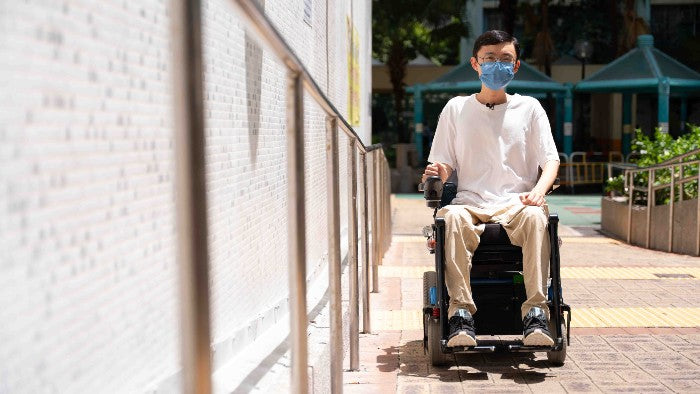
HKU graduate with muscular atrophy - Tseung Wai Kwan
Duchenne muscular dystrophy forced Devin to learn acceptance.
Accepting life with a wheelchair, not pursuing his dream career, unable to hold a camera...
But it couldn't make him accept giving up:
"There are many things you can try. Don't think you can't do anything just because of the illness."

Three years of love couldn't withstand the test of a rare disease
"Which hurts more, breaking up or the illness?" "Wow... that's a tough one..." Devin, 24, chuckled and thought for a moment. "It's probably the breakup, because the breakup was due to this illness." The Duchenne muscular dystrophy that had plagued him for over a decade brought his three-year relationship to an end. "I told her a lot about my feelings back then, some calmly, some with a broken heart."
"Maybe as she (his girlfriend) got older, she wanted to be cared for more, rather than constantly caring for me," Devin smiled helplessly. Four months after the breakup (as of the interview day), the wound was still bleeding, "the illness itself is also bleeding... haha." Behind the laughter, he still harboured resentment. "I blame myself for having this illness, I blame heaven."


Seeking truth from various doctors
As a child, Devin was no different from other children. But in early primary school, he started to stumble and fall for no apparent reason. His family took him to Caritas Medical Centre. He remembered that the doctor initially planned to perform a muscle biopsy, but he was afraid of the pain. "Because the doctor had to use a very thick needle to extract tissue, but in the end, no sample was taken." Later, a blood test was performed, and he was diagnosed with Duchenne muscular dystrophy at the age of nine.
"At that time, the doctor couldn't tell me how bad my body would get." His family learned from the doctor that Devin's physical condition would continue to deteriorate, both in muscle strength and cardiorespiratory function, and that he might only live until his twenties or early thirties. So, they sought medical advice everywhere, even seeing traditional Chinese medicine doctors in mainland China and taking Chinese herbal medicine for conditioning, but to no avail. When reality couldn't be changed, "facing it" was their only option.

Child to adult
Even as a primary school student, Devin had learned to comfort himself. "Of course, there were times when I was unhappy at first, but I told myself that even if I was unhappy, it wouldn't change anything. Instead, I told myself not to be unhappy all the time."
The helplessness brought by the illness made Devin more mature than his peers. From the moment he fell ill, he was forced to adapt to being different from others. In primary school PE classes, "I couldn't do much," and while other classmates engaged in strenuous exercise, he could only sit and watch. When classmates went upstairs, he had to take the lift.
"There were times when I fell and couldn't get up, feeling helpless and unable to move. I also felt why it was so unfair." In Form 1, he started using a wheelchair. "At first, I was quite resistant. Even if walking was very difficult, I would park my wheelchair as soon as I got to school and walk on my own within the school. I walked very slowly, sometimes needing help." However, as his muscles gradually atrophied, he eventually had to accept going directly to the classroom in a wheelchair.

Mainstream school was the top choice
In fact, when he was entering secondary school, doctors suggested that he choose a special school because it would have better resources for treatment and facilities. However, after much deliberation, he ultimately chose to enrol in a mainstream school with a faster academic pace.
"Although my limbs and muscles are not as good as theirs, I can keep up with them academically. And after finishing school, I will have to go out into society and interact with others."

Classmates were the antidote to dealing with the illness
It turned out his decision was right. "Meeting friends at school made me happy again." He remembered the warmest moment was when everyone went to a country park to do a photography assignment, and several classmates worked together to carry Devin and his wheelchair down the stone steps.
The encouragement and help from friends supported him through every difficult moment.

Diligence and self-discipline are part of daily life
The physical weakness brought by the illness affected his studies, but he was willing to put in more effort than others to overcome it: Does he get tired and find it hard to absorb information when revising? He spends more time to achieve the same results. Does he write slowly? He applies for extended time for exams.
His efforts also paid off – he fulfilled his dream of studying biotechnology at the University of Hong Kong. "(Choosing this major) wasn't just out of interest, but mainly because of this illness. I wanted to understand more about its causes and if there were other treatment methods." However, reality disappointed him – current technology has no cure, only medication to slow down the degeneration.


Facing difficulties, finding solutions
Graduation was another moment when a dream was shattered. "From primary school to secondary school, I wanted to work in a laboratory-related field, but later I realized my body really couldn't handle it, so I stopped thinking about it." He turned to seeking jobs in public organisations that are more accommodating.
"I had many interviews during secondary school, but never heard back." However, he persisted and rose to the challenge. This time, within a year, he found an administrative job at a charity organisation. He said this is what he appreciates most about himself: "When I encounter difficulties, I don't shy away; I find ways to solve them."
This job, working as a computer technician in a sheltered workshop dormitory, allows him to help more people in need. "Although I am also ill, there are many people in this world who are more severely affected than me. Sometimes I think I'm lucky that I can still help them, and that gives me a sense of satisfaction."

Phone replaces camera
He loves watching movies and photography, and used to specifically go to scenic spots to take photos, waiting for the best moment to capture sunsets. However, as his condition progressed, it became increasingly difficult for him to lift a heavy camera, so he switched to using his phone. But the degenerating muscles imposed more and more limitations on him. "My hands used to be more flexible, making it easier to adjust angles. Now it's much harder, so I take fewer photos."
The team suggested installing a tripod on his wheelchair. "Before, I could move my body more and take photos from more angles, but now, even with a tripod, the angles are very limited."
Among his many works, the one he remembers most vividly was taken at the Sai Wan pier. "Because there was a person in the photo also taking pictures, holding a camera," "it seemed so easy for others to just pick up a camera and shoot," he said, with a hint of subtle envy in his voice.
He set a photo of Tamsui scenery taken during a trip to Taiwan with his family as his phone background. For him, photography is not just a hobby, but more of a lifestyle and an observation of the world. Whenever he picks up his phone and captures those beautiful moments, he feels a sense of satisfaction. Through photography, he records his communication with the world.
Accept reality and cherish the present
Besides picking up a camera, Devin finds it increasingly difficult to do things he used to be able to do, such as holding chopsticks, unlocking doors, or pulling toilet doors. Although he can go to work independently, he faces many challenges on the way, such as pressing lift buttons. "I used to be able to press it with one hand, but now I might need to use my other hand to help. You face these things when you go out, and sometimes you have to find ways to do them yourself."
Daily life also requires assistance from others. For example, his parents help him put on his ventilator before bed and help him get up, and his sister helps him with things. Seeing his parents frequently suffer from back pain, and aches in their hands and feet in recent years, "sometimes I feel sorry for them and get upset." His parents never treated Devin differently or complained because of his condition; they treated him the same as his healthy sister, who is in Form 1. "Although I might not be able to help much physically, I do take care of my sister in other ways." "She doesn't need my help with her studies; she's even better than me." A proud smile couldn't be hidden from his lips when talking about his sister.
Watching his body gradually weaken, he doesn't see his life as counting down. "I know I will definitely get worse, but I won't try to guess how long I'll live because you can't predict these things," "just let nature take its course, there's nothing else I can do." He says this with ease now, but it's a sentiment that has taken over a decade to form.


Plans to continue his studies and hopes to become a social worker
Devin still has a great passion for life and is planning his future. He is considering pursuing a master's degree to become a social worker, which would allow him to help others and feel a sense of accomplishment. He also attends seminars now, sharing his experiences to inspire others. "I remember a patient who wasn't yet in a wheelchair, and they couldn't accept the idea of being in one in the future. I told them how to think about it, that there's no need to resist."
He encourages other rare disease patients not to give up when faced with difficulties, and not to feel useless, as everyone has something admirable about them. "Although the illness can't be changed, there are still many things you want to do that you can try. Don't think you can't do anything just because of the illness."

Interview and writing: Yeung Lok Yee, Chan Wai Kai
Editing: Leung Kim Hung, Chan Wai Kai
Photography: Sea.Pho.Yea, Ken Mok
Video production: Lifewire, Ken Mok, Sea.Pho.Yea
Some photos provided by the interviewee
Required equipment relies on rental
A physiotherapist visits Devin's home weekly for an hour and a half of therapy to slow down muscle degeneration, making a stretching bed and leg braces essential equipment. The cost of purchasing equipment and medical expenses adds to Devin's financial burden; for instance, a wheelchair costs over a hundred thousand dollars, and a ventilator for sleep can easily cost tens of thousands. Fortunately, some equipment can be rented, which is more cost-effective. "Even if the ventilator breaks down, you only pay the monthly rent, and you don't have to pay for repairs."