Mind Trapped in Body - Ka-ki
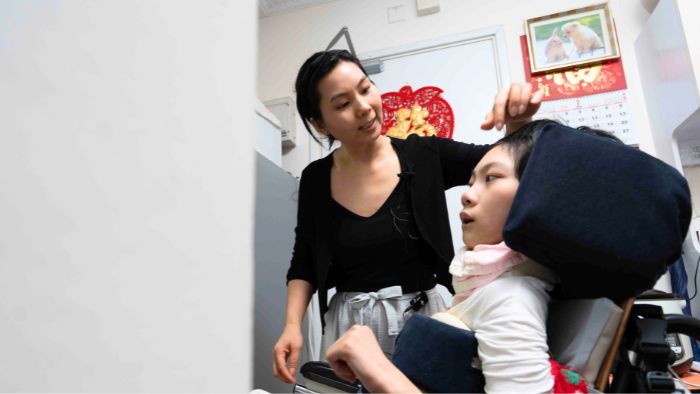
"Do you want pork chop rice or chicken chop rice? Look this way for pork chop rice," her mother says, shaking her left fist in front of Ka-ki’s eyes. "And look this way for chicken chop rice," she adds, shaking her right fist. Lying on the sofa, unable to speak or control her body, Chen Ka-ki scans her mother’s hands back and forth before finally resting her gaze on the left. With her eyes, she tells her mother her choice.
Whether it is a meal choice or deciding between the wheelchair and the sofa, mother and daughter communicate through a constant series of multiple-choice questions. Yet, from the very moment Ka-ki entered this world, she was confronted with the ultimate choice of life: to live, or to die.

A Soul Trapped in a Spastic Body
"Ka-ki (19) has athetoid cerebral palsy. Doctors say this type is quite difficult because her mind is fully aware of everything, yet her limbs, hands, and feet simply won't obey her, and she cannot speak," her mother says while massaging Ka-ki’s calves on the sofa.
Lying on the sofa nearby, Ka-ki struggles to turn her head toward her mother, but her body and limbs defy her control, tensing and contorting in the opposite direction. All she can do is let out "uh-uh" sounds in protest. Her petite mother understands the meaning instantly and, with great effort, lifts her daughter to reposition her.
The contracted tendons and muscles act like a straitjacket, tightly binding Ka-ki’s body. She must struggle repeatedly just to straighten her arm; at mealtimes, she has to strain to open her mouth for the spoonful of food her mother offers. Her mother must seize that fleeting moment when her mouth opens to deliver the food. It is a constant, relentless battle; finishing a single bowl of chopped noodles takes over an hour, leaving Ka-ki frail and weighing only 50-some pounds.
Athetoid Cerebral Palsy (Dyskinetic Cerebral Palsy) is a movement disorder or dyskinesia caused by brain damage. Typically, patients have no control over their limbs and are unable to speak; however, their intelligence and life expectancy are no different from those of a healthy person.


Neglect in prenatal checkups
Recalling the year I was carrying Jiaqi, my mother said that during the last ultrasound of the prenatal checkup, the amniotic fluid was contaminated with meconium, making it hard to see clearly. The nurse, considering previous checks were normal, did not take it seriously. The butterfly flaps its wings gently, and a small oversight stirred up a storm in the lives of Jiaqi and my mother.
'It was only at natural birth that we discovered Jiaqi was wrapped around the neck by the umbilical cord four times,' the tiny body suffocated and turned purple, with brain hypoxia. My mother still remembers every word the doctor said at that time: 'The doctor asked whether to attempt resuscitation; resuscitating might lead to sequelae, possibly affecting intelligence.' 'I didn’t think too much at that moment, I just felt that it was a life and hoped she could see this world.'
Jiaqi struggled back to life from the brink of death, charming and lively, but even at five months old, her neck was still weak, and her whole body limp. My mother carried her everywhere seeking medical treatment, and the result was a diagnosis of severe athetoid cerebral palsy in Jiaqi.
Doctor: Don't think back.
"I remember crying heavily at that time, never thinking that one decision of mine would ruin a child's life," the tears carried remorse and self-blame.
"The doctor told me, there are many things you shouldn't dwell on; thinking back is meaningless and pointless."


The long road
Because of work, dad was constantly traveling between Hong Kong and mainland China, while mom single-handedly took care of Jiaqí, running back and forth, going to Shenzhen and Foshan for physical therapy and acupuncture, not letting go of any hope.
"Back then, early in the morning, I would hold her and take the bus to the hospital, spending the whole day there." "The hardest times, I would hold her alone on a long-distance bus for several hours to go to Foshan for acupuncture, and then stay there for more than twenty days."
"One time was really tough, crying until I lost my voice. She had undergone acupuncture for more than half a year at the hospital, but it completely didn't help Jiaqí, so we had to go to other places hoping it could help her." It was the New Year, a time that should have been for family happiness, but mom held three-year-old Jiaqí standing on a strange street, with no idea what the future held.
"It was really hard, nobody could help you or understand you, and you couldn't see any hope. The road ahead was still so long, I didn't know what to do," mom sobbed, "I don't even know how I got through it back then." She felt lost, desperate, but never gave up.
"Sometimes when taking her for physical therapy, the therapist would joke, 'She's that serious, why did you choose to save her?' But I felt that many things aren't 100% hopeless. There might be a chance for improvement, maybe she could be healthy."
"Sometimes, seeing the discomfort her body caused her..." Originally quiet Jiaqí suddenly started crying and waving her arms and legs, and mom hurriedly comforted her, "Because it touches the issues in her heart, she feels very distressed, so she cries."
"Sometimes, when discussing her problems with the school social worker, she would cry upon hearing it. The worker said that this is a way of expressing herself, and after crying she might feel a bit better, because she feels that someone understands her."

Choose one of the two answers
Jiaqi can only express herself through her eyes and voice. Occasional movements like turning over or casually changing TV channels all require help from others. A mother and daughter share a deep connection; the piercing screams to outsiders are a language that only her mother can understand. With enough patience and careful guesswork, one can enter Jiaqi's inner world.
Should she turn around or sit up? Does she want to watch TV or use the iPad? 'If I want to watch TV, I look to the left; if I want the iPad, I look to the right.' Looking at the fist her mother holds in front of her eyes, all those unspoken answers are hidden in Jiaqi’s eyes. Eyes are the windows to the soul and the bridge between Jiaqi and the world.
If her mother guesses correctly, Jiaqi will try to make an approving 'mm… mm' sound; if she looks at her stomach at the wrong time, her mother will guess: 'Want to go to the bathroom? Does it hurt there?' During interviews, Jiaqi watches the interactions between the Lifewire team and her mother, occasionally expressing agreement with a 'mm… mm' sound, her eyes closely following these strangers.
A way to express a choice between two options with a fist: 'Maybe she needs a lot of things, sometimes it's really hard to guess, and she gets very frustrated.'
'The social worker teacher also thinks that Jiaqi may have more emotional issues.'
'It feels like she used to be happier; all the old photos show her smiling, but in the past two years, there have been fewer smiles. As she grows older, there are more emotions.'
Her mother gently stroked Jiaqi's hair and said with a bit of sighing.

The pain of growing up
Entering adolescence, Jiaqi developed more of a habit of biting her lower lip. Whenever she got nervous, she would bite it until it bled, with old injuries not healed yet new ones forming, causing her lower lip to become deformed. Her mother felt heartbroken and helpless, only able to place towels for cushioning; when they became wet and dirty, she would replace them with another one. Every day, she had to wash over 30 towels, and the ones torn from biting were countless.
Taking care of her became increasingly difficult for her mother. "She used to be smaller and not so tall," "When she was younger, she didn’t have so many uncontrollable movements." In recent years, the muscles in her limbs have also become increasingly tight. "Before, her leg muscles were not so tense, she could stand for a short while, but starting last year, she hasn’t been able to stand because her muscles became tighter and contracted, unable to straighten. She needs relaxation medication to sleep."
"Feeding her is the hardest part, because I have to hold her, possibly feeding her for an hour, and afterward, my whole body aches." In recent years, Jiaqi’s pelvis has also protruded, causing pain and increasingly crooked sitting; after surgery, although her sitting posture improved, the wound is expected to take a year to heal, so she currently relies on painkillers, and one leg has become several inches shorter.

Taking care is enjoyment, not hardship
Jiaqi loves to eat, especially cake sushi, and her mother is also grateful that she can eat. Enjoying the flavors and going shopping are Jiaqi's happy moments. "When I go out with her, the other ladies see us and ask if taking care of her is very hard? Actually, it's not hard for me; it's much harder for the child." As she spoke, her mother's eyes gradually became moist.
Every morning, she takes Jiaqi to school, then buys ingredients to prepare lunch at home, delivers it to school to feed her personally, and later picks her up after school. She puts all her time into Jiaqi, running back and forth, but she says she enjoys it: "At least the child can go to school and doesn't have to be stuck at home or in the hospital, bored."
Some friends suggested sending Jiaqi to a boarding school, but she flatly refused, preferring to handle everything personally. She also feels uneasy about hiring a maid for help and hopes to save money to buy delicious food for her daughter.
The only person who understands her besides her family
Jiaqi loves Hello Kitty the most. The large Hello Kitty doll at home was a gift from the social worker and teachers who care for Jiaqi. In the photos that her mother took out, besides the pictures of her mother with a youthful and innocent face holding baby Jiaqi, and little Jiaqi lying on the bed looking at the camera playfully, there are many photos of the mother and daughter traveling with classmates and teachers. They went to Tsim Sha Tsui, to the M+ Museum, to Cheung Chau... Jiaqi in a wheelchair, along with her mother and classmates, showed radiant smiles on the ferry, feeling the freedom brought by the sea breeze.


There is also a photo of a pink handmade little handbag. "On Mother's Day, the teacher asked Ka Qi what she wanted to make for her mom, and she made a handbag for me, purposely choosing her favorite pink color." Mom couldn't hide her smile, recounting every detail, "Sometimes when she makes cookies at school, she says she wants to save some for me. When the girls see me, they say, 'Ka Qi says she saved it for you.' She always thinks of me and wants to share with me." Mom melted into a smile as she spoke.
Ka Qi loves going to school. "But a few classmates have already graduated," and a close male friend even calls to check on Ka Qi after leaving school, making her so happy she beams with joy. But Ka Qi also has to graduate, leaving behind not only her family but also the only people who understand her.
Mom is grateful to the school social workers, who, in response to Ka Qi's emotions and difficulties, allowed her to postpone graduation for a year while looking for ways to help her communicate. They finally found a computer operated by eye-tracking, the 'eye-control device,' which allowed Ka Qi to express her thoughts trapped inside her spastic body.
Push open the closed window
However, the equipment is not cheap, and the monthly expenses for formula, diapers, nutritional supplements, medications, and follow-up visits left the family with no extra resources to afford them. Fortunately, with the help of a social worker, they got in touch with 'Care Network.' After understanding the situation, 'Care Network' immediately provided funding for the purchase. The teacher and social worker also tried to use the time before graduation to train Jiaqi to master its use. 'Now that she has an eye-control device, she is visibly happier.'


Regret after speaking
Do you regret the choice you made to save your child that day? On every restless night, Jiaqi's mother asked herself this question. During the day, Jiaqi's bleeding lips and painful cries tormented a mother. After so many years, Jiaqi's mother can now frankly say she regrets—not regretting bringing Jiaqi into this world, but regretting bringing her into this world without giving her a healthy body. The only thing left is to move forward with Jiaqi, to walk out a path that belongs to the two of them.
No longer looking to the future
"About seven or eight years ago, I had a thought, that one day, maybe when I’m older or not in good health, I might not be able to take care of her, so what would happen then..." Before the voice even fell, the tears had already come. The feeling of helplessness and despair, which once fed thoughts of suicide, made her consider leaving this world together with Jiaqi.
But at some point, she awakened to the fact that no matter how difficult the times are, they will pass.
"From the day she was born until now, all these years, although we’ve lost a lot, there have also been happy moments. At least I have a daughter who has been with me all these years, and I have always been there for her. We rely on each other."
What about the future? Who can know? At least for now, mother and Jiaqi love each other, support each other, and together walk from the past into the future!
